
Marcel Duchamp escaped artistic categories by questioning whether art needed to be painted, handmade, original, or even conventionally beautiful.
Francis Picabia created a different problem.
He kept painting—and repeatedly made his previous identity unusable.
Picabia moved from convincing Impressionist landscapes to pioneering abstraction, mechanomorphic Dada imagery, grotesque couples, layered “Transparency” paintings, photo-derived nudes, deliberately unfashionable figurative work, and late abstraction. Each reinvention could look like a rejection of the one before it.
That volatility is the subject of Picabia: Open the Gates of Night, at Milan’s Palazzo Reale from October 9, 2026, through January 24, 2027. Curated by Anne Berest Picabia, the artist’s great-granddaughter, the exhibition is the largest Italian retrospective devoted to Picabia and gathers more than 170 paintings, drawings, photographs, documents, and archival materials.
The Palazzo Reale exhibition frames night as a metaphor for desire, war, artistic freedom, and continuous transformation.
Its deeper argument is that Picabia’s inconsistency was not a weakness.
It was his method.
Picabia Began By Becoming Someone Else
Francis Picabia was born in Paris in 1879 to a French mother and a Spanish-Cuban father.
He first gained recognition during the early 1900s as a painter of Impressionist landscapes. These works were accomplished enough to establish a successful career, yet Picabia soon abandoned the style that had brought him attention.
By 1912, he was producing large abstract compositions influenced by Cubism, Futurism, dance, music, and movement. His work appeared at New York’s landmark 1913 Armory Show, where European modernism confronted a large American audience.
That shift set the pattern for his career.
Picabia did not treat artistic development as steady refinement.
He treated style as something temporary.
New York Turned Bodies Into Machines
During World War I, Picabia spent time in New York, where his friendship with Marcel Duchamp became central to the emergence of American Dada.
Picabia began drawing and painting machines that behaved like portraits.
Mechanical diagrams became erotic bodies.
Pistons, gears, wiring, and industrial components suggested desire, personality, frustration, and human relationships.
These works were not celebrations of efficient technology. Picabia’s machines are often dysfunctional, absurd, or sexually charged.
The modern body becomes a faulty mechanism.
The mechanism becomes a psychological caricature.
This period connected Picabia and Duchamp closely, but it also revealed an important difference.
Duchamp increasingly moved away from painting.
Picabia kept returning to it—only to make painting contradict itself.
391 Made Reinvention Public
Picabia launched the avant-garde journal 391 in 1917, modeling its title partly on Alfred Stieglitz’s New York gallery and journal 291.
The publication became a vehicle for poetry, visual experiments, provocation, typography, insults, machines, and attacks on artistic respectability.
Picabia understood that an artist’s public persona could become part of the work.
Controversy was not an accidental consequence.
It was another medium.
He participated in Dada’s Paris activities after the war but publicly rejected the movement in 1921, declaring that it had stopped being new. In 1924, while Breton was formalizing Surrealism, Picabia attacked the emerging group in 391.
He repeatedly approached movements, extracted their possibilities, and left before affiliation could become permanent.
Duchamp’s Refusal Became Coherent
Duchamp is famously difficult to classify.
Yet his rejection of conventional painting developed into a remarkably coherent conceptual legacy.
The readymade questioned authorship.
Chance weakened control.
Rrose Sélavy destabilized identity.
Exhibition design became artistic practice.
Duchamp’s refusal produced a recognizable set of questions about what art could be.
Picabia’s refusal was less orderly.
He did not replace painting with one durable conceptual program. He moved from one incompatible visual language to another, often embracing precisely what his avant-garde audience had learned to reject.
For more context on that contrast, thesurrealists.org’s live article on Marcel Duchamp’s rule-breaking legacy explains how Duchamp’s independence ultimately became foundational to Conceptual art.
Duchamp made escaping categories look systematic.
Picabia made the system itself unstable.
The “Monsters” Made Bad Taste Productive
During the 1920s, Picabia produced works frequently called his Monster paintings.
These images depict distorted couples, exaggerated faces, embraces, kisses, and sexual encounters through crude outlines, lurid colors, and deliberately awkward anatomy.
They appear to reject refinement.
That rejection was provocative because modernism had already developed its own standards of sophistication. An avant-garde style could become respectable once museums, critics, and collectors learned how to recognize it.
Picabia responded by making paintings that looked vulgar, comic, sentimental, or incompetently drawn.
The “badness” was strategic.
If good taste had become another convention, bad taste could become another route toward freedom.
The Transparencies Layered Several Histories At Once
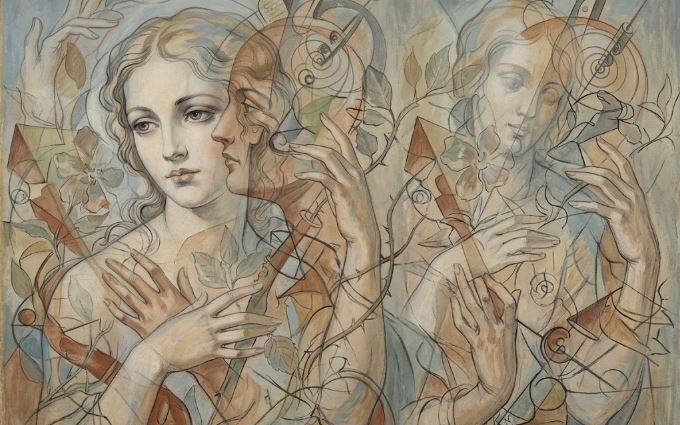
Around 1928, Picabia began producing the works known as his Transparencies.
In these paintings, several figures overlap across the same surface. Faces, hands, animals, plants, classical sculptures, religious imagery, and references to earlier European artworks appear simultaneously.
No single figure dominates.
The eye moves among layers without settling on one stable scene.
Picabia borrowed imagery from reproductions of Renaissance and classical art, then combined it until historical periods became difficult to separate.
The result resembles memory rather than narrative.
Past images remain visible but incomplete.
The Transparencies also complicate his relationship with Surrealism. Their superimposed bodies can feel dreamlike, occult, and psychologically unstable, yet Picabia arrived at them without submitting to Breton’s artistic program.
He remained close enough to Surrealism to share its fascination with unstable identity.
He stayed distant enough to avoid becoming one of its dependable representatives.
The Kitsch Paintings Were An Even Greater Betrayal
During the late 1930s and 1940s, Picabia began making figurative paintings based partly on commercial photographs, glamour imagery, movie publicity, and pin-up models.
These works disturbed critics who expected a former Dada provocateur and abstraction pioneer to remain visibly avant-garde.
The paintings could appear glossy, sentimental, erotic, or embarrassingly conventional.
That discomfort was part of their significance.
Picabia treated supposedly discredited popular imagery as usable material. He ignored the modernist belief that serious art should demonstrate forward progress toward a purer or more advanced style.
Decades later, Pop art, appropriation art, and postmodern painting would make similar questions unavoidable.
Can an artist use mass-media imagery without endorsing it?
Does artistic seriousness require good taste?
Can copying become invention?
Picabia entered that territory before it had become institutionally fashionable.
He Returned To Abstraction Without Making It A Resolution
After World War II, Picabia returned to Paris and again shifted direction.
His late paintings moved back toward abstraction, often using dense signs, dots, swollen shapes, and totemic forms.
A conventional career narrative might present this as a return to his authentic modernist self.
Picabia’s history makes that reading impossible.
The late abstraction does not cancel the Impressionist landscapes, machines, Monsters, Transparencies, or kitsch figures.
Each phase remains part of the same career.
In 1949, Duchamp described Picabia’s work as a “kaleidoscopic” sequence of artistic experiences.
The description remains apt because a kaleidoscope does not progress toward one final image.
It keeps rearranging the same field into new configurations.
Inconsistency Became Picabia’s Most Consistent Principle
The MoMA profile of Francis Picabia preserves one of his most revealing statements: “If you want to have clean ideas, change them like shirts.”
The sentence sounds flippant.
It also defines his artistic philosophy.
Picabia distrusted identities once they became clean, stable, and repeatable. A movement could become a prison. A recognizable style could become a brand. Even rebellion could harden into convention.
His solution was not simply to reject style.
It was to keep changing styles before any one of them became permanent.
This makes Picabia unusually relevant to contemporary culture, where artists move across painting, fashion, music, social media, design, performance, archives, and commercial imagery without always preserving one coherent visual identity.
Picabia anticipated the idea that contradiction itself could form a practice.
Why Picabia Is Harder To Classify Than Duchamp
Duchamp and Picabia both resisted movement identity.
Their legacies diverged because Duchamp’s resistance eventually became recognizable as a conceptual position.
Picabia never granted viewers that stability.
Was he an Impressionist?
An abstraction pioneer?
A Dadaist?
A Surrealist fellow traveler?
A painter of grotesques?
A classicizing artist?
A kitsch provocateur?
A precursor to Pop and appropriation?
A late abstractionist?
Every answer is correct for part of the career and misleading for the whole.
That is why Open the Gates of Night matters.
The exhibition does not reveal one true Picabia hidden beneath changing styles.
It presents transformation itself as the subject.
Duchamp made modern art question whether an object needed to look like art.
Picabia posed an even less comfortable question:
What if an artist never needs to look like the same artist twice?