
René Magritte belonged unmistakably to Surrealism.
He joined the Belgian Surrealist circle in the 1920s, moved to Paris in 1927, associated with André Breton, Paul Éluard, Max Ernst, and other members of the movement, and developed some of the most recognizable images in modern art.
Yet Magritte’s larger cultural achievement may have begun after Surrealism stopped functioning as an organized avant-garde.
Pipes that deny being pipes.
Apples blocking faces.
Clouds appearing where they should not.
Bowler-hatted businessmen multiplied into patterns.
Rooms overwhelmed by oversized objects.
Paintings within paintings that make reality and representation impossible to separate.
Those devices escaped art history and became part of everyday visual culture.
That afterlife is the subject of This Is Still Not a Pipe: The Afterlife of Magritte, on view at Gagosian Grosvenor Hill in London from September 24 through December 12, 2026.
Organized with the Fondation Magritte, the current Magritte exhibition combines works from across his career with art by more than 40 artists from different generations, including Vija Celmins, Robert Gober, Jeff Koons, Mona Hatoum, Ed Ruscha, Sarah Lucas, Maurizio Cattelan, Dana Schutz, Alex Da Corte, Glenn Ligon, Betye Saar, and others.
The exhibition makes a provocative case almost inadvertently.
Magritte may matter today less because he perfected one form of Surrealist painting than because he taught later artists—and eventually advertising, photography, cinema, design, memes, and digital imagery—how to make familiar images stop behaving reliably.
Magritte Entered Surrealism Through A Different Door
Magritte was born in Lessines, Belgium, in 1898.
His early art passed through Impressionism, Futurism, and Cubism before a decisive encounter with Giorgio de Chirico changed his direction.
De Chirico demonstrated that ordinary things could become mysterious without losing their recognizable appearance.
A statue.
A train.
A glove.
A building.
Nothing needed to melt or dissolve.
The mystery came from context.
Magritte adopted that lesson and pushed it toward a distinctive form of Surrealism.
Unlike artists who pursued automatic drawing or biomorphic abstraction, he usually painted recognizable objects with cool, almost impersonal precision.
The Museum of Modern Art’s Magritte research emphasizes this contrast: rather than relying primarily on automatism, Magritte used carefully rendered ordinary things to challenge the apparent stability of the real world.
That decision would become enormously important later.
His pictures were easy to recognize.
Their logic was not.
The Treachery Of Images Became Bigger Than A Surrealist Joke
Few paintings have had a longer conceptual afterlife than The Treachery of Images (1929).
Magritte painted a pipe and placed beneath it the famous sentence:
Ceci n’est pas une pipe.
This is not a pipe.
The statement sounds absurd only for a moment.
Then its logic becomes unavoidable.
It is not a pipe.
It is an image of a pipe.
Magritte exposed a gap that visual culture usually encourages viewers to ignore: an image and the thing it depicts are not identical.
That seems obvious.
It is also one of the central problems of contemporary image culture.
A photograph is not the event.
A digital avatar is not the person.
An advertisement is not the product.
A generated image is not necessarily evidence that anything depicted ever existed.
A social-media profile is not identical to the life behind it.
Magritte’s painted pipe therefore escaped its original Surrealist context.
It became a compact philosophy of representation.
His Afterlife Grew Because He Distrusted Images
Many Surrealists wanted images to reveal hidden psychological realities.
Magritte often did something stranger.
He made viewers distrust the image itself.
A painting could show something perfectly clearly while simultaneously making its meaning uncertain.
This is why his work feels unusually compatible with contemporary culture.
We live inside images.
News arrives through images.
Political identities circulate through images.
Advertising depends on them.
AI systems now manufacture increasingly convincing ones.
Digital editing makes photographic evidence unstable.
Magritte’s basic lesson—that seeing something does not guarantee understanding it—has become more relevant, not less.
That may be his most important legacy.
Words Could Not Stabilize Reality Either
Magritte did not only destabilize pictures.
He destabilized language.
In works such as The Key of Dreams, ordinary objects appear beside words that may not correctly name them.
A shoe might receive an unexpected label.
A familiar thing can suddenly lose the word normally attached to it.
The strategy undermines an assumption viewers rarely notice.
We believe names stabilize objects.
Magritte demonstrates how arbitrary that stability can be.
Language does not simply reveal reality.
It organizes it.
Change the word and the image begins behaving differently.
That idea later became enormously important to Conceptual art, text-based art, advertising, semiotics, and contemporary practices concerned with how language structures perception.
Magritte’s paintings are visually memorable.
Their deeper influence may be linguistic.
The 2026 Exhibition Makes This Afterlife Visible
Gagosian’s London exhibition deliberately places Magritte beside artists who did not simply imitate his style.
That is important.
Influence does not require painting apples, clouds, or bowler hats.
Robert Gober can transform ordinary domestic objects into psychologically loaded sculptures.
Maurizio Cattelan can use an absurd intervention to destabilize the authority of an art object.
Mona Hatoum can make familiar household forms feel threatening.
Vija Celmins can enlarge an ordinary eraser until scale itself becomes strange.
Ed Ruscha can make language behave simultaneously as image and statement.
These artists inhabit very different practices.
What links them to Magritte is a method.
Take something familiar.
Alter one condition.
Let certainty collapse.
An Apple Became A Machine For Making Faces Disappear
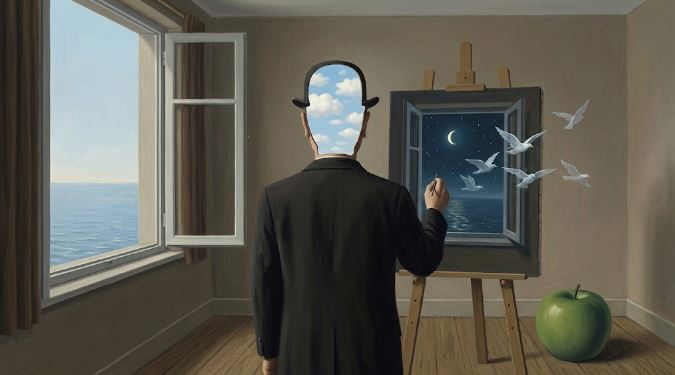
Magritte’s The Son of Man (1964) is now so widely reproduced that its strangeness risks becoming invisible.
A man in a dark overcoat and bowler hat stands before a low wall.
The sea and sky appear behind him.
A green apple blocks most of his face.
The image is simple enough to reproduce endlessly.
That simplicity is part of its power.
The apple prevents identification while inviting it.
The viewer wants to see behind it.
The obstruction creates desire.
Later artists, photographers, filmmakers, designers, and advertisers have repeatedly used comparable strategies.
Hide the face.
Replace it.
Mask it.
Interrupt it with an object.
The device has become a common part of visual culture.
Magritte helped make concealment as psychologically active as revelation.
The Bowler Hat Became A Symbol Without A Fixed Meaning
The bowler-hatted man recurs throughout Magritte’s work.
He can resemble an anonymous bourgeois citizen.
A self-portrait.
A bureaucrat.
A generic modern man.
In Golconda (1953), dozens of similarly dressed men appear suspended or falling across a cityscape.
The repetition makes individuality unstable.
Is every man separate?
Are they copies?
Are they falling?
Floating?
Standing somehow against the sky?
Magritte gives no final answer.
That refusal matters.
Later visual culture learned to use repeated anonymous figures to express conformity, corporate identity, bureaucracy, mass society, simulation, and cloning.
Once again, Magritte’s motif became more culturally portable than its original Surrealist context.
Scale Became One Of His Most Durable Tricks
Magritte repeatedly altered scale.
An apple becomes too large for a room.
A comb becomes architectural.
An ordinary object expands until the space containing it stops making sense.
The technique is simple enough to describe in one sentence.
Its descendants are everywhere.
Advertising enlarges products until they dominate cities.
Cinema turns ordinary objects into gigantic threats.
Digital art routinely shifts scale without regard for physical possibility.
Memes place unrelated objects into absurd proportions.
Surrealist painters did not invent distortion of scale, but Magritte refined it into an immediately readable visual device.
His influence survives because the method is easy to understand and endlessly reusable.
He Made The Image Work Like A Puzzle Without Giving A Solution
Magritte is often described as philosophical because his paintings resemble visual propositions.
Yet they rarely provide neat answers.
That is a crucial distinction.
A conventional puzzle promises resolution.
Magritte frequently withholds it.
Why does a locomotive emerge from a fireplace in Time Transfixed (1938)?
Why does the mirror in Not to Be Reproduced (1937) show the back of a man’s head instead of his reflection?
Why can a painted landscape align perfectly with the landscape supposedly behind the canvas?
The viewer understands the contradiction.
Understanding does not solve it.
This makes Magritte different from an artist who simply illustrates a dream.
He constructs logical systems with one impossible rule.
That method has proved extraordinarily durable.
Contemporary Digital Culture Is Almost Magrittean By Default
Modern image technology makes many of Magritte’s once-impossible situations effortless.
Objects change scale instantly.
Faces disappear.
Skies enter rooms.
People duplicate.
Perspective collapses.
Text contradicts images.
Synthetic photographs depict events that never happened.
Generative AI can create perfectly plausible representations of impossible situations in seconds.
Technically, none of this makes the resulting imagery Surrealist.
But the perceptual problem feels distinctly Magrittean.
The image looks convincing.
The event may be impossible.
Viewers have to negotiate the gap between visual credibility and factual reality.
Magritte spent decades exploring exactly that gap with paint.
Memes Inherit More From Magritte Than They Realize
Internet memes often operate by placing familiar images into unexpected conceptual relationships.
A recognizable picture receives new text.
The meaning changes.
An image migrates away from its original context and becomes a reusable template.
Magritte’s practice anticipated some of this logic.
He understood that the relationship between object, image, title, and word could be rearranged endlessly.
The same picture can mean differently depending on what it is called.
The same object becomes strange when relocated.
A contradiction can communicate faster than an explanation.
That combination makes Magritte unusually compatible with the compressed logic of online visual culture.
His Influence Also Changed Conceptual Art
Magritte’s impact reaches well beyond popular imagery.
Artists associated with Conceptual art found enormous value in his insistence that the idea behind an image could matter more than pictorial virtuosity.
The London exhibition acknowledges that legacy through artists whose work depends heavily on conceptual displacement.
The important inheritance is not Magritte’s painting style.
It is his habit of questioning categories.
Image versus object.
Word versus thing.
Inside versus outside.
Reality versus representation.
Original versus copy.
Visible versus hidden.
Those binaries became some of postwar art’s most productive problems.
Even His Most Famous Motifs Refuse To Stay His
Apples, pipes, clouds, curtains, hats, mirrors, birds, windows, and suited men now circulate far beyond Magritte.
That diffusion can look like overexposure.
Yet it also demonstrates extraordinary cultural penetration.
Very few Surrealists created such a reusable visual vocabulary.
Dalí’s melting watches remain strongly identified with Dalí.
Magritte’s strategies have become more anonymous.
A giant object inside a room may feel “Magritte-like” even when nobody explicitly references him.
A floating businessman can suggest Magritte without reproducing a specific painting.
A contradiction between caption and image can feel Magrittean without resembling his visual style.
That is what an artistic afterlife looks like when it becomes larger than direct influence.
His Original Surrealism Was Only The Beginning
Magritte died in Brussels in 1967.
Historical Surrealism had already fragmented substantially by then.
Yet his influence kept expanding.
Pop artists recognized the power of commonplace commercial objects.
Conceptual artists explored the unstable relationship between words and things.
Postmodern artists questioned representation and originality.
Photographers played with concealment and simulation.
Advertisers borrowed his visual contradictions.
Filmmakers adopted his impossible normality.
Digital culture made image manipulation ordinary.
Now AI-generated imagery has intensified the problem Magritte raised almost a century ago:
what exactly are we looking at?
Readers interested in a very different Surrealist approach to constructing reality can explore thesurrealists.org’s verified feature on Remedios Varo’s science, magic, and enigmatic worlds.
Varo constructed intricate imaginary worlds.
Magritte made the ordinary world itself impossible to trust.
The Afterlife May Be The Bigger Achievement
This Is Still Not a Pipe: The Afterlife of Magritte remains at Gagosian Grosvenor Hill through December 12, 2026.
Organized with the Fondation Magritte and curated by Jasper Sharp and Bernard Lagrange, the exhibition spans Magritte’s career while placing his works beside those of more than 40 later artists.
Its premise ultimately reveals why Magritte’s afterlife may matter more than his original place in Surrealism.
Historical Surrealism gave him a movement.
Magritte produced a visual grammar capable of surviving without one.
Change an object’s scale.
Hide a face.
Misname an image.
Place something ordinary where it should not be.
Make the picture contradict itself.
Leave the contradiction unresolved.
Those moves now belong to contemporary visual culture as much as they belong to Magritte.
His greatest trick was not convincing viewers to enter a Surrealist dream.
It was convincing them that ordinary images could never again be entirely trusted.