
Minnie Evans never belonged to André Breton’s Paris circle. She did not sign a Surrealist manifesto, participate in the movement’s political arguments, or build her art around Freudian theory. Her visual language emerged from a very different place: vivid dreams, Christian faith, family history, the natural abundance of coastal North Carolina and experiences she understood as spiritual revelations. Yet stand before one of Evans’s densely patterned drawings and the comparison with Surrealism becomes difficult to ignore. Faces grow out of flowers. Eyes multiply inside symmetrical architectures. Human, animal and botanical forms merge until their identities become unstable. Images seem to arrive from somewhere beyond conscious planning.
That tension makes The Lost World: The Art of Minnie Evans, now at the Whitney Museum of American Art in New York, such a timely exhibition. Open from August 22, 2026, through January 10, 2027, the retrospective returns Evans to the Whitney more than five decades after her 1975 solo museum exhibition there. Organized by the High Museum of Art in Atlanta and curated by Katherine Jentleson, the exhibition brings Evans’s dream-driven art back into a conversation that has changed dramatically since the 1970s. The Whitney’s Minnie Evans exhibition describes a practice shaped by Afro-Caribbean heritage, mythology, religion, popular culture, decorative arts and the natural environment of Wilmington, North Carolina.
The question is no longer whether Evans can simply be inserted into Surrealism. A more revealing question is why her independently developed visionary practice sometimes arrived at effects that Surrealist artists were pursuing through entirely different intellectual routes.
The Whitney Returns To Minnie Evans After More Than 50 Years
Evans’s return to the Whitney carries considerable historical weight.
The museum presented a one-person exhibition of her work from July 3 through August 3, 1975, at a time when museums offered comparatively little institutional space to Black self-taught artists. The Whitney’s 1975 exhibition archive preserves that important moment in her career.
The new exhibition does something broader. Rather than presenting Evans chiefly as an extraordinary individual discovery, it places her life, working conditions and visual development within American art history.
Evans was born in Long Creek, North Carolina, on December 12, 1892, and grew up largely in Wilmington. She left school after the sixth grade and spent much of her working life in domestic employment. She later became associated with Airlie Gardens, first through the families connected to the property and then as the public garden’s gatekeeper.
According to Airlie’s historical records, Evans began managing its gate around 1948–1949 and remained there until retiring in 1974. She often made drawings during quiet periods and displayed or sold works near the entrance. The garden itself—with azaleas, live oaks, flowers, winding vegetation and ornamental structures—became inseparable from the dense organic imagery of her mature work. Airlie Gardens’ Minnie Evans history documents the unusual relationship between Evans’s employment, visions and artistic production.
This setting already complicates comparisons with European Surrealism.
Breton’s movement developed through cafés, journals, manifestos and avant-garde networks.
Evans developed much of her visual language at a garden gate in North Carolina.
Her First Drawings Came From An Experience She Considered Spiritual
Evans’s artistic beginning has become central to her biography because she described it in unusually direct terms.
She had experienced dreams and waking visions since childhood. After the death of her grandmother in 1934, those experiences intensified. On Good Friday in 1935, at age 42, she produced the two small pen-and-ink works now known as My Very First and My Second.
Both works are now in the Whitney’s collection.
The images already contain characteristics that would become fundamental to Evans’s art: concentric structures, repeated lines, strange glyph-like marks and forms that hover between abstraction and recognizable imagery. The Whitney dates My Second to 1935 and identifies its medium simply as pen and ink on paper, yet its visual organization looks surprisingly complex for an artist at the beginning of a sustained practice.
Evans did not describe this process as an intellectual experiment.
She believed something demanded that she make images.
The Smithsonian American Art Museum preserves one of her clearest statements about her method. Evans said she did not plan drawings and described them as simply happening. The Smithsonian’s Minnie Evans biography connects her art to lifelong dreams, day visions, religious conviction and an imagined spiritual order populated by human faces, animals, plants, angels and other hybrid beings.
That distinction is critical.
The Surrealists deliberately sought methods for loosening conscious control.
Evans believed the images were being given to her.
The visual resemblance can be strong even when the explanation behind it is radically different.
Automatic Drawing Creates The Most Tempting Surrealist Comparison
One reason Evans now enters discussions of expanded Surrealism is her drawing process.
André Breton defined Surrealism in 1924 around psychic automatism: an attempt to allow thought to operate with reduced rational supervision. Artists such as André Masson pursued automatic drawing by beginning without a predetermined subject and allowing lines to generate unexpected forms.
Evans independently described something remarkably close at the level of physical procedure.
The High Museum’s exhibition research recounts her description of making My Very First. After writing a grocery order, she began making marks on the remaining paper without knowing why and continued as forms accumulated. The High Museum’s Minnie Evans retrospective explicitly identifies automatic drawing as an important element in her earliest work.
Yet similarity of process does not prove shared artistic ideology.
Masson’s automatism emerged from a Surrealist project concerned with unconscious thought, Freudian association and resistance to rational control. Evans interpreted her unplanned marks through spiritual experience, faith and revelation.
That difference protects Evans from a misleading retrospective label.
Calling her simply a Surrealist risks transforming her own explanations into evidence for someone else’s movement.
The better comparison recognizes convergence.
Two artists can release conscious planning and produce unexpected images without arriving there through the same history.
Dreams Meant Something Different To Evans Than They Did To Breton
Dreams form an even more obvious bridge.
European Surrealists treated dreams as evidence that rational waking consciousness represented only part of human mental life. Freud’s writings helped make dreams a privileged route into unconscious desire, repression and association.
Evans’s dreams belonged to another system of meaning.
She understood many of them spiritually.
The High Museum notes that Evans connected her imagery to what she called the “lost world,” which she associated with peoples or civilizations destroyed before the biblical Flood. Her drawings could contain angelic beings, ancient-looking faces, invented symbols and architectures that appear simultaneously botanical and sacred.
The current exhibition takes its title from that concept.
That matters because viewing Evans through Surrealism alone can secularize an art she experienced through faith.
Her visions were not simply psychological material waiting for interpretation.
They could function as messages.
The same distinction applies to her recurring eyes. Within European Surrealism, an eye might suggest voyeurism, psychic rupture, erotic anxiety or the instability of perception. Evans’s repeated eyes can operate within religious ideas of omnipresence and divine observation.
A similar-looking symbol can belong to a profoundly different imaginative structure.
This is where thesurrealists.org’s earlier examination of Remedios Varo’s science, magic, and enigmatic worlds offers a useful contrast. Varo developed inside Surrealist networks and deliberately fused occultism, science and fantasy. Evans reached visionary hybridity without passing through those same circles.
Their images may occasionally seem like neighbors.
Their roads toward them were not.
Airlie Gardens Helped Turn Nature Into Something Visionary
Evans’s mature art cannot be separated from plants.
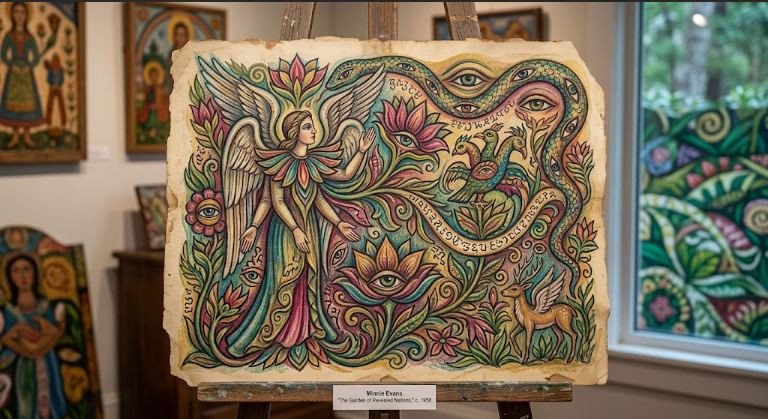
Flowers crowd her compositions. Leaves become architectural decoration. Human faces appear embedded in vegetation. Butterfly-like shapes, eyes, petals and radiating forms repeat until the border between organism and ornament becomes difficult to locate.
Airlie Gardens supplied Evans with an extraordinary daily visual environment.
The property near Wilmington now encompasses more than 67 acres of gardens, live oaks, trails and historic structures. Evans spent decades seeing its flowers and foliage while working at the gate. Airlie Gardens still honors her through the Minnie Evans Bottle Chapel, a sculptural tribute designed by Virginia Wright-Frierson and completed in 2004.
The relationship between garden and artwork should not become too literal. Evans did not simply copy plants she saw around her.
She reorganized nature.
Flowers become faces.
Faces become ornaments.
Eyes become seeds or petals.
Symmetry turns vegetation into something almost architectural.
That transformation helps create the surreal quality of her work. Reality remains visible but refuses to stay in one category.
Surrealist artists frequently relied on metamorphosis for similar visual tension. A body could merge with landscape; an object could become animal-like; biological forms could appear inside architecture.
Evans reached metamorphosis through a visual vocabulary grounded in gardens, faith and personal revelation.
Nature became spiritual structure.
Her Afro-Caribbean Heritage Complicates The “Outsider Artist” Label
Evans has often appeared under labels such as “folk artist,” “visionary artist,” “naive artist” and “outsider artist.”
Each term can provide historical context.
Each can become restrictive.
The Whitney now stresses the range of sources inside her imagery, including her Afro-Caribbean heritage. Evans traced part of her maternal ancestry to Trinidad, while her visual culture absorbed biblical stories, mythology, decorative design, popular imagery and the environment of North Carolina.
This wider framework changes how her work should be read.
A label such as “outsider” can suggest that an artist exists beyond culture and produces imagery from an isolated internal source. Evans did nothing of the kind. Her art developed inside family traditions, Southern history, Christian belief, racial inequality, domestic labor, garden culture and an expanding awareness of visual material.
She spent much of her life in the Jim Crow South.
That historical setting cannot become decorative biographical background.
The High Museum organized The Lost World partly to examine what Evans’s working life and social circumstances contributed to her art alongside her extrasensory experiences. Its exhibition brings together more than 100 works, moving from relatively spare 1930s drawings into the elaborate, colorful compositions associated with her later career.
This approach resists a romantic myth of the visionary artist floating outside history.
Evans’s imagination was extraordinary.
Her life remained materially specific.
Nina Howell Starr Helped Move Evans From A Garden Gate To New York Museums
Evans’s wider recognition did not happen automatically.
Photographer and arts advocate Nina Howell Starr encountered her work in the early 1960s and became a major supporter, representative and archivist. Starr helped organize exhibitions, documented Evans through photographs and recorded extensive conversations with her.
By 1966, Evans’s work had reached New York.
A 1969 Newsweek profile increased national attention. Museum exhibitions followed. In 1975, Starr guest-curated Evans’s solo exhibition at the Whitney.
MoMA’s Minnie Evans research describes Starr as instrumental in bringing the artist to a broader audience and identifies their collaboration as a major factor in the 1975 Whitney retrospective.
The relationship also preserved something especially valuable: Evans’s own voice.
Without recorded interviews, later historians might have had far more freedom to impose theoretical explanations on her imagery. Evans repeatedly explained that dreams and visions mattered to her, that she did not consciously plan many drawings and that she understood her artistic activity through spiritual obligation.
Those statements should limit how confidently critics translate her work into Surrealist theory.
Visual comparison remains productive.
Replacing Evans’s interpretation with Breton’s is not.
The Whitney Exhibition Makes Surrealism A Question Rather Than An Answer
The current retrospective arrives during a broader reconsideration of Surrealism’s borders.
Recent exhibitions have moved beyond the old assumption that Surrealism equals a small collection of European artists surrounding Breton. Museums increasingly examine international networks, women artists, political contexts and practices that intersected with Surrealist ideas without fitting neatly inside official membership.
Evans presents an even more difficult case.
The High Museum itself says the exhibition explores how she fits into expanded canons of Surrealism.
That wording is useful.
It does not claim Evans belonged to the historical Surrealist movement.
It asks what becomes visible when the canon grows large enough to consider parallel practices.
Her art shares several characteristics with Surrealism: automatic mark-making, dream imagery, metamorphosis, hybrid creatures, unstable distinctions between human and natural forms, and a willingness to let rational coherence break down.
Its foundations remain different.
The Smithsonian once described Evans’s works as “surrealistic” rather than reducing their significance to Surrealist affiliation. That distinction may still be the most precise one available.
Her images can feel surreal.
Her worldview does not need Breton to explain them.
Why Minnie Evans Makes Surrealism Look Less Exclusive
The strongest lesson of The Lost World may concern Surrealism as much as Minnie Evans.
If dream imagery, automatic processes and metamorphosis only count when they pass through Parisian theory, art history risks turning a set of human imaginative possibilities into the property of one European movement.
Evans demonstrates why that approach fails.
She found extraordinary images through a combination of dreams, faith, memory, nature and involuntary-looking mark-making. Her art can resemble Surrealism because Surrealism did not invent dreaming, visions, hybrid forms or the experience of discovering images before consciously knowing what they mean.
The movement gave those experiences a particular theoretical framework.
Evans gave them another.
That is why her work can feel more genuinely strange than art designed to announce itself as surreal. Its mysteries do not resolve when the viewer identifies a technique or influence. An Evans drawing can remain simultaneously botanical, human, religious, decorative and abstract.
The categories do not settle.
The Whitney’s exhibition, organized at the museum by curator Barbara Haskell with curatorial assistant Caroline Webb, keeps that uncertainty productive through January 10, 2027. More than fifty years after Evans first received a solo Whitney exhibition, her work returns to an art world more prepared to ask what happens when established categories fail.
Minnie Evans did not need to become a Surrealist for her visions to unsettle reality.
The more revealing possibility is that her art shows how many routes can lead toward the surreal—and how much art history misses when every strange dream is traced back to Paris.