
A curtain, mirror, dinner table or cocktail glass does not need to become physically impossible before it can feel surreal. In GaHee Park’s paintings, the disturbance often begins somewhere less dramatic. A body divides strangely. An animal seems too interested in a private encounter. Food becomes erotic or faintly threatening. A woman appears to be watched, then seems to take control of the act of looking. The domestic interior remains recognizable, yet its social rules begin to slip.
That tension is at the center of GaHee Park: Behind the Curtain, which opened at San Francisco’s Yerba Buena Center for the Arts on August 7, 2026, and remains on view through January 3, 2027. Curated by Dorothy Dávila, the exhibition is Park’s first solo institutional exhibition in the United States and brings together recent paintings from roughly the last five years. YBCA describes them as investigations of fantasy, sexuality, mortality, identity and alienation, staged through ambiguous private moments. The museum’s Behind the Curtain exhibition presents Park explicitly as a surrealist painter whose women do something historically important: they complicate the viewer’s right to look.
Park’s work raises a larger question for contemporary Surrealism. What happens when the dream does not begin in an exotic wilderness, cosmic void or imaginary city, but in the room where someone eats, drinks, desires, hides and waits to be seen?
Park Makes The Domestic Interior Psychologically Unstable
GaHee Park was born in Seoul, South Korea, in 1985 and now lives and works in Montreal. She received a BFA from Tyler School of Art in Philadelphia and an MFA from Hunter College in New York. Her paintings have appeared in exhibitions at institutions including the Milwaukee Art Museum and Pond Society in Shanghai, and works have entered collections including the Institute of Contemporary Art, Miami, and Columbus Museum of Art.
Yet biography alone does not explain why her interiors feel so peculiar.
Park repeatedly builds scenes from materials associated with ordinary private life: tables, curtains, beds, windows, fruit, flowers, drinks, mirrors and bodies at rest. These components initially suggest intimacy or comfort. Their relationships soon become harder to read.
Insects appear where social etiquette would prefer they did not. Fish can occupy the same psychological weight as human figures. A hand may become separated from the body that should control it. A face can acquire more than one mouth. Familiar proportions become unreliable without collapsing into complete fantasy.
YBCA’s July 2026 exhibition announcement describes Park’s images as both erotic and unsettling, rendered through muted grays and pinks and structured around reversals between interior psychology and the external environment.
The room does not illustrate a character’s mind.
The room begins behaving like one.
Her Surrealism Starts With Privacy Rather Than Escape
Historical Surrealism often turned toward dreams and unconscious association as ways of escaping the restrictions of rational thought. Park’s paintings complicate that model by making privacy itself a contested condition.
In a 2020 interview with Ocula, Park connected her interest in domestic space with growing up in a patriarchal household where personal privacy was limited. She recalled using notebooks as private places for expression and even hiding sections of them from view. That history later expanded into her studio and paintings. The full GaHee Park interview provides valuable context for why interiors in her work function as psychological territories rather than neutral rooms.
This makes the phrase Behind the Curtain particularly effective.
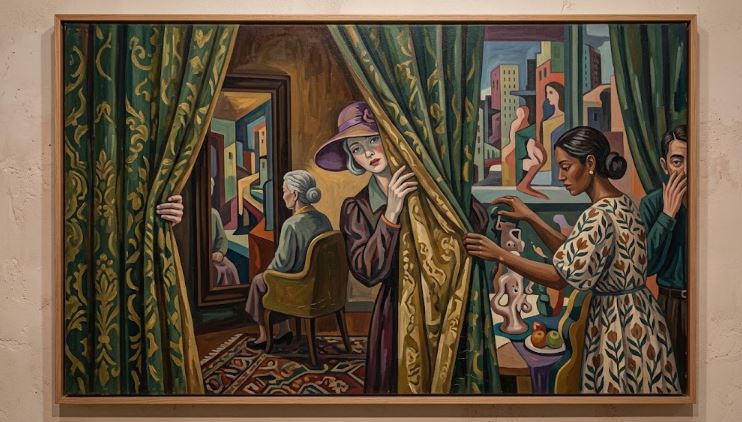
A curtain separates public from private. It can conceal a body or reveal one. In theater, it separates spectators from the constructed world of a performance. In a home, it blocks the gaze coming through a window.
Park’s paintings repeatedly activate those tensions.
Private space offers freedom, yet someone may still be looking.
Eroticism can signify pleasure, yet being visible can introduce vulnerability.
A woman can become the subject of a picture without remaining passive inside it.
The domestic interior becomes an unstable border between personal desire and social surveillance.
That gives Park’s Surrealism a distinctly contemporary pressure. She is less interested in escaping everyday life than in exposing how much fantasy, restriction and performance already exist inside it.
The Female Figure Is No Longer Simply Waiting To Be Looked At
The history of Surrealism contains a long and difficult relationship with the female body.
Women frequently appeared in Surrealist imagery as fragmented bodies, erotic objects, muses, mysterious symbols or projections of male desire. Women associated with the movement—including Leonora Carrington, Remedios Varo, Claude Cahun, Dorothea Tanning, Toyen and Leonor Fini—complicated that tradition by creating their own images of sexuality, identity and transformation.
Park enters this history from a different generation.
Jessica Silverman Gallery describes her paintings as transforming the female nude from passive sexual object into a psychologically complicated subject. Its GaHee Park artist profile argues that she does not solve problematic traditions by abandoning them. She enters those traditions deeply enough to expose their contradictions.
That distinction can be seen in Park’s recurring concern with gaze.
Who is watching?
Who realizes they are being watched?
Who controls what the viewer is permitted to see?
A painted woman may seem exposed, yet her expression can remain inaccessible. Mirrors create extra viewpoints without producing certainty. Windows promise access to another space, then turn looking itself into the subject.
The approach connects Park to a much older Surrealist debate about women’s agency without making her work a revival of 1930s painting. Readers interested in another artist who transformed inherited Surrealist imagery through female subjectivity can compare Park’s approach with Remedios Varo’s science, magic, and enigmatic worlds, where interior worlds likewise become spaces for autonomy rather than decorative fantasy.
Park’s rooms are less mystical than Varo’s.
They may be just as psychologically loaded.
Animals And Food Make Ordinary Rooms Feel Uncanny
Park’s domestic scenes rarely belong to humans alone.
Snails, insects, cats, ducks, fish and other creatures appear beside bodies, furniture and food. Their presence can be comic, sensual or uncomfortable. Sometimes an animal seems to be another spectator inside the painting.
That ambiguity is especially effective in works connected with Behind the Curtain.
YBCA describes contemplative women staring into cocktail glasses as insects, snails and sardines occupy nearby spaces. The resulting compositions refuse a clear hierarchy between human life, appetite and animal existence.
A related painting, Seafood Heaven (2024), places marine creatures alongside a human form after the apparent aftermath of an ocean wave. Park later included Nagisa Ōshima’s The Ceremony (1971) in the exhibition’s associated film program, and YBCA notes that viewers may recognize the cinematic shot that inspired Seafood Heaven. The museum’s Through an Open Window film series makes Park’s relationship with cinema unusually visible.
The painting becomes more than a strange seafood tableau.
Consumption, death and beauty occupy the same image.
A fish can be a living organism, food or visual ornament. A flower can signify beauty and decay. An insect can be unwanted in a room yet perfectly natural within an ecosystem.
Park repeatedly moves objects between such categories.
That instability is one reason her paintings feel surreal without depending on spectacular impossibility.
Cinema Reveals How Park Constructs The Act Of Watching
One of the most revealing parts of the YBCA project exists outside the gallery walls.
Park and filmmaker Michael Vass co-curated Through an Open Window, a weekly film series running from August 15 through October 31, 2026. YBCA describes the program as a personal survey of cinematic influences connected with Park’s interest in voyeurism, theatricality, social taboo, mistaken identity, dream sequences and stories contained inside other stories.
The opening selection, Alfred Hitchcock’s Rear Window (1954), makes the relationship easy to understand.
Hitchcock turns domestic architecture into a viewing machine. Windows divide private lives into frames. The protagonist watches his neighbors, and the audience watches him watching them. Pleasure, suspicion and intrusion become impossible to separate.
Park’s paintings can operate through a related structure.
A curtain creates a partial barrier.
A mirror introduces another viewpoint.
A figure looks away from the spectator.
Another body enters from the edge.
The viewer becomes conscious of occupying a position outside the room.
That makes Park’s domestic Surrealism partly theatrical. Her interiors do not pretend viewers are invisible. They make the awkwardness of spectatorship one of the painting’s subjects.
Park’s 2026 Moment Extends Beyond YBCA
Behind the Curtain arrives during a particularly active period in Park’s career.
Earlier in 2026, Perrotin New York presented Half-Looking, Half-Seen from April 24 through May 30. The paintings used seascapes, bodies and animals to examine conditions in which figures exist between perceiving and being perceived. The exhibition functioned almost like a prelude to the larger institutional presentation in San Francisco.
Park’s recent visibility also extends into public and architectural settings. She participated in the Palais Garnier’s PROJECT 12 residency in April 2025, part of the Paris Opera building’s 150th-anniversary program. The official Palais Garnier residency characterized her work through romantic and intimate scenes interrupted by incongruous Surrealist details.
In 2026, Jessica Silverman Gallery lists a large-scale glass mosaic commission for JFK Airport’s Terminal 6 among Park’s projects and has scheduled her first solo exhibition with the gallery for October 28.
These projects place Park’s work in several very different viewing environments: private gallery, contemporary art institution, opera house and airport architecture.
The shift is significant for an artist so preoccupied with looking.
A painting of privacy changes meaning when thousands of strangers move past it.
Is GaHee Park Reinventing Domestic Surrealism?
Calling Park a Surrealist does not mean placing her inside André Breton’s historical movement as if the intervening century disappeared.
YBCA itself uses the term, and Park’s images clearly engage strategies that Surrealism helped establish: fractured bodies, irrational combinations, unstable identity, erotic psychology and the transformation of ordinary objects.
Her difference lies in where those strategies operate.
Park does not need to construct distant dream kingdoms.
The bedroom is enough.
So is the dinner table.
So is a cocktail.
So is the uncomfortable awareness that someone may be watching through a window.
Her paintings turn domestic life into a site where social restrictions, desire and imagination remain entangled. They question who controls private space and whose fantasies are permitted to occupy it. The female body can be erotic without surrendering its psychological authority. An interior can feel safe and claustrophobic at the same time.
That tension gives Behind the Curtain more weight than a fashionable revival of Surrealist imagery.
Park is using Surrealism as a method for examining the politics of ordinary intimacy.
The historical Surrealists searched for marvelous encounters capable of breaking rational reality apart. Park suggests that contemporary life may require less searching. Desire, anxiety, performance and absurdity are already present in the room.
All that is needed is to pull back the curtain.