
A chessboard looks like the opposite of Surrealism. Sixty-four squares impose order. Six kinds of pieces obey fixed rules. Every legal move belongs to a system that existed before either player sat down. Man Ray saw something stranger inside that structure. Chess created a controlled space where planning collided with surprise, desire met aggression, and a familiar object could be redesigned until it felt alien.
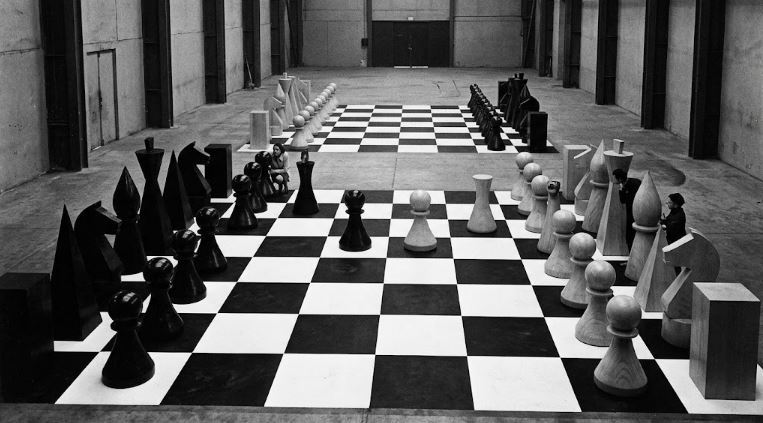
That idea drives Man Ray, the exhibition at Take Ninagawa in Tokyo running from August 1 through October 3, 2026. The gallery brings chess-related works together with rayographs, paintings, sculptures and objects to examine chess as what it calls a “generative structure” within Man Ray’s art. At the center is his monumental, playable Giant Chess Set (1961), a work Man Ray himself used. The gallery’s Man Ray exhibition argues that chess mattered to him far beyond the subject of a game: it created a field where multiple possible moves existed inside strict limits and where order could suddenly produce the unexpected.
That framing gives the Tokyo exhibition its importance. Man Ray is still routinely summarized as a photographer who invented rayographs and produced some of Surrealism’s most recognizable images. Chess reveals another route into his thinking. He did not simply photograph strange things. He repeatedly built systems in which objects could stop behaving as expected.
Chess Let Man Ray Put Chance Inside A System
Man Ray’s attraction to chess contains a contradiction that fits his work unusually well.
Chess is governed by rules, yet no two serious games unfold in exactly the same way. A player’s choices generate new possibilities and close others. Calculation matters, but another person’s decisions can destroy a plan immediately. Structure creates unpredictability rather than eliminating it.
MoMA describes Man Ray as enjoying precisely that mixture of strategy and spontaneity. The museum’s 1920–1926 Chess Set turns standard chess figures into reduced geometric forms whose identities depend on associations rather than literal representation. The king becomes a shape linked to an Egyptian pyramid. Other pieces lose the figurative ornament that had made traditional chess sets easy to recognize. MoMA’s Man Ray chess set records how the artist redirected his enthusiasm for the game into designing new forms for its pieces.
The Metropolitan Museum of Art holds an earlier 1920 wooden Chess Set and interprets the game as a recurring metaphor across Man Ray’s practice. The Met points to multiple directions and moves, structure and surprise, violence and sexuality as themes the artist associated with chess. Its Man Ray Chess Set makes clear that the board offered him far more than a decorative motif.
This is where the idea of a “Surrealist machine” becomes useful.
The board does not produce random chaos. It generates unexpected situations through a limited set of rules.
Man Ray repeatedly sought that same tension in art.
His Chess Pieces Turned Familiar Identities Into Visual Riddles
Traditional chess pieces announce what they are through inherited forms. Crowns mark kings and queens. Horses identify knights. Castle towers identify rooks.
Man Ray stripped away much of that visual storytelling.
His redesigns reduced the pieces to cones, cubes, spheres and other elementary forms. Recognition became an act of interpretation.
A player had to look twice.
That small disturbance is deeply connected to Surrealist perception. A familiar object retains enough of its identity to remain recognizable, yet something has shifted. The viewer moves from instant recognition into uncertainty.
Man Ray used that strategy far beyond chess.
An iron could become an object of menace once fitted with metal tacks. A metronome could acquire an eye. Everyday objects placed directly onto photographic paper could dissolve into luminous silhouettes through a rayograph.
The recent Metropolitan Museum of Art exhibition Man Ray: When Objects Dream, presented from September 14, 2025, through February 1, 2026, examined this movement between media on an unusually large scale. It placed roughly 60 rayographs alongside about 100 paintings, objects, prints, drawings, films and photographs, showing that transformation, indeterminacy and unstable identity ran through his entire practice. The accompanying Man Ray: When Objects Dream study connects his photographic experiments to his objects and paintings rather than treating rayographs as an isolated achievement.
Tokyo’s chess-centered exhibition picks up that argument from another direction.
The pieces become objects caught between symbol and abstraction. They remain useful enough to play a game, yet their appearance refuses conventional expectation.
A Chessboard Could Behave Like A Rayograph
At first glance, a chess set and a rayograph have little in common.
One is a game object. The other is a cameraless photograph.
Man Ray’s work makes the connection easier to see.
In the winter of 1921, he began making the photographs he called rayographs by placing objects on or near light-sensitive paper and exposing the arrangement to light. The objects left traces, shadows and translucent forms. Ordinary items could become difficult to identify once their photographic outlines replaced their physical appearance.
The Met’s recent research describes rayographs as images balanced between representation and abstraction. An object remains present through its trace, yet that trace can make the original thing hard to name. The Met’s Man Ray research places chance, transformation and uncertainty at the center of this work.
Man Ray’s chess pieces perform a related operation in three dimensions.
A bishop stops looking like a traditional bishop. A king stops looking like a miniature monarch. The function survives after the image changes.
That is the same kind of visual friction produced by many rayographs: identity persists without remaining visually secure.
For readers following this side of Man Ray’s work, thesurrealists.org’s overview of Man Ray’s Surrealist photography innovations provides a useful companion to the Tokyo exhibition. The camera work and the chess objects belong to the same broader habit of making ordinary things lose their certainty.
The Board Made Control And Accident Cooperate
Surrealism is often described through freedom: automatic writing, unconscious association, chance encounters and rebellion against rational order.
Man Ray’s chess obsession reveals a more complicated version of that freedom.
Total disorder rarely interested the Surrealists for long. Many of their strongest methods created conditions in which control could be interrupted rather than erased.
Automatic writing still required language.
The exquisite corpse still used folded paper and agreed procedures.
Collage depended on existing printed material.
Rayographs required physical objects, photographic paper, exposure and development.
Chess follows the same pattern. The rules remain fixed. What happens inside them stays unpredictable.
That tension helps explain why the game could remain productive for Man Ray across decades. He designed chess sets more than once rather than treating the 1920 version as a finished experiment. MoMA’s silver-plated version dates from 1920–1926, and Take Ninagawa’s 2026 exhibition reaches forward to the monumental Giant Chess Set of 1961.
Forty years separate those objects.
The recurring return suggests that Man Ray saw something durable in chess: a model for generating variation without abandoning form.
A machine repeats operations.
A chessboard repeats rules.
The results can still surprise everyone involved.
Chess Joined Man Ray’s Dada And Surrealist Instincts
Man Ray occupies an unusually fluid position between Dada and Surrealism.
Born Emmanuel Radnitzky in Philadelphia in 1890, he developed his early experimental work in New York before moving to Paris in 1921. His friendship with Marcel Duchamp connected him to a culture fascinated by games, language, mechanical systems, absurdity and attacks on conventional artistic value.
Chess fitted this environment almost perfectly.
A chess piece has use, symbolism and sculptural form at the same time. It can belong to a game, become a design object or enter an artwork without changing its physical identity.
Man Ray exploited that ambiguity.
This explains why the Tokyo exhibition’s combination of chess sets, rayographs, paintings and sculpture is more illuminating than a chess-only display would be. Take Ninagawa explicitly builds on the broader research prompted by Man Ray: When Objects Dream, shifting attention from the rayograph toward the role of objects across his art.
The shift challenges another habit in Man Ray’s reputation.
Photography made him famous.
Objects may reveal more clearly how he thought.
The Giant Chess Set Changes The Player Into Part Of The Artwork
Scale changes the meaning of a chess piece.
A normal pawn sits between a player’s fingers. A giant piece occupies physical space alongside the player’s body.
That transformation gives Giant Chess Set (1961) special force within the Tokyo exhibition.
Take Ninagawa describes it as both monumental and playable. This matters. The work does not turn chess into a sculpture that must be admired from a safe distance. It preserves the game’s capacity for action.
A viewer can understand the pieces as forms.
A player has to move among them.
The body enters the system.
That shift recalls a recurring Surrealist fascination with destabilizing scale. An everyday item made unnaturally large stops feeling neutral. Familiarity turns theatrical. Objects begin to dominate people rather than remaining passive tools.
Chess already dramatizes conflict through miniature figures. Enlarging those figures reverses the relationship.
The player’s symbolic army becomes a physical environment.
The chessboard starts to resemble a stage.
That gives Man Ray’s 1961 work an experiential quality that connects unexpectedly well with later installation art. The object is no longer simply represented. The spectator’s movement becomes part of how the work functions.
Violence And Desire Were Already Built Into The Game
Take Ninagawa’s interpretation of Man Ray’s chess practice includes two striking terms: violence and sex.
Those ideas may sound excessive until the symbolic structure of chess comes into view.
The game turns conflict into abstraction. Pieces capture one another. Players sacrifice figures for strategic advantage. A king faces constant threat. The board converts destruction into elegant procedure.
At the same time, the pieces carry identities shaped by hierarchy and gender: king, queen, bishop, knight, pawn.
Man Ray did not need to add narrative for those associations to exist. He could redesign the figures and allow their relationships to carry psychological tension.
The Met makes the same connection in its description of his 1920 set, identifying violence and sex among the metaphoric possibilities Man Ray extended from chess into film and painting.
This is where chess moves closest to Surrealist thought.
The surface looks rational.
Desire and aggression operate underneath it.
That contradiction resembles the movement’s broader challenge to polite modern culture. Surrealists repeatedly searched beneath respectable surfaces for impulses society preferred to disguise.
A chessboard can look civilized precisely when it stages symbolic warfare.
Tokyo Reveals A Man Ray Larger Than Photography
The 2026 Take Ninagawa exhibition arrives at a useful moment in Man Ray scholarship.
The Met’s recent retrospective restored the rayograph to the center of his work without reducing him to photography. Tokyo takes the next step by asking viewers to follow one object—the chessboard—across media and decades.
That strategy creates a different Man Ray.
He appears less like a photographer who occasionally made objects and more like an artist who used whatever medium could activate a problem.
Photography could turn things into shadows.
Sculpture could make familiar forms alien.
Film could disrupt movement and sequence.
Chess could turn rules into surprise.
The connection between those practices lies in transformation rather than medium.
That reading fits Take Ninagawa’s decision to show rayographs, paintings and sculptures beside chess-related material. The exhibition does not claim that every Man Ray artwork secretly represents chess. It proposes that the game’s logic can help viewers recognize a structure running beneath much of his art.
Order produces disruption.
Recognition produces uncertainty.
Rules produce unexpected outcomes.
Objects refuse to remain ordinary.
Why Chess May Be One Of Man Ray’s Best Surrealist Objects
Man Ray once described himself modestly as a “third-rate player,” according to MoMA’s account of his chess practice. His importance to chess culture never depended on competitive skill.
He was interested in what the game could become once an artist looked at it differently.
The chessboard gave him an existing system that already contained several qualities Surrealism valued: conflict, desire, uncertainty, strategy, symbolism and surprise. He did not have to destroy its rules. He could alter its forms and expose the strange possibilities hiding inside them.
That distinction makes the Tokyo exhibition more than an unusual Man Ray footnote.
It offers a compact model of his creative practice.
A rayograph begins with an ordinary object and lets light estrange it.
A Man Ray chess piece begins with an ordinary function and gives it an unfamiliar body.
A giant chess set begins with a tabletop game and turns it into an environment.
Each operation changes the viewer’s relationship with something recognizable.
Take Ninagawa’s exhibition remains open through October 3, 2026, with a temporary closure scheduled from August 29 through September 5. For visitors who know Man Ray mainly through photography, the show offers a chance to encounter the logic connecting his camera, objects and games. Take Ninagawa’s current exhibition schedule confirms the dates and temporary closure.
Chess did not become Surrealist for Man Ray by abandoning logic.
It became Surrealist when logic started generating things no one could fully predict.
That may be why he returned to the board for so long. Chess offered him a ready-made machine for one of his favorite artistic situations: the precise moment when control produces surprise.