
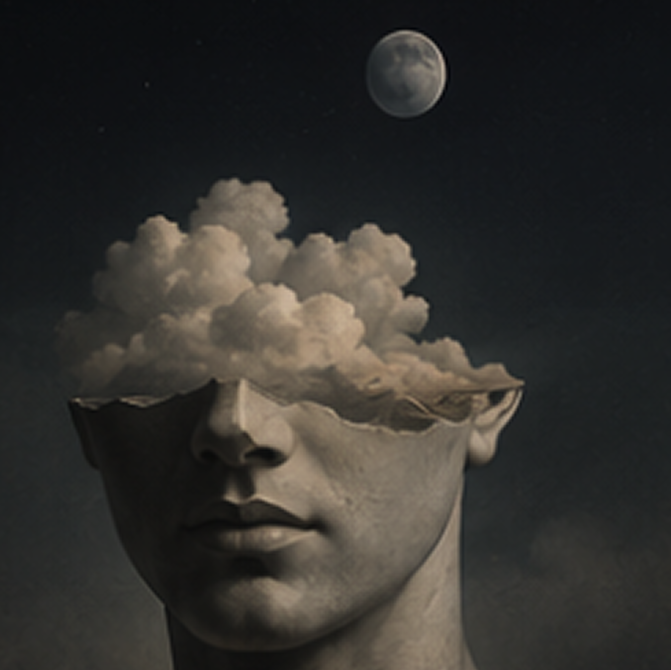
Surrealism is still most easily recognized through paintings: Salvador Dalí’s impossible landscapes, René Magritte’s visual paradoxes, Max Ernst’s hybrid creatures. Yet the movement’s most disruptive experiments often happened somewhere smaller, cheaper and more intimate—the book. MoMA’s forthcoming The Surrealist Book: Tomorrow Lives in Mirrors, opening in New York on October 4, 2026, makes that argument unusually tangible. Running through January 23, 2027, the exhibition gathers rare books by André Breton, Claude Cahun, Salvador Dalí, Paul Éluard, Max Ernst, Toyen, Unica Zürn and other figures who treated pages, bindings, photographs, typography and printed language as raw artistic material.
The radical difference was structural. A painting confronted a viewer as a finished surface. A Surrealist book could unfold slowly, conceal images, interrupt language, force collaboration and physically transform as someone handled it. MoMA describes books as central vehicles for Surrealist experimentation and for spreading the movement’s revolutionary ideas. MoMA’s exhibition overview presents them not as illustrated supplements to painting but as artworks capable of merging literary, visual and political action.
That makes Tomorrow Lives in Mirrors more than an exhibition about rare publications. It asks viewers to reconsider where some of Surrealism’s most aggressive experiments actually occurred.
The Surrealists Did Not Treat Books As Containers
A conventional illustrated book separates roles cleanly. The writer writes. The artist supplies images. The designer packages the result.
Surrealist books repeatedly broke those boundaries.
Words collided with photographs. Images disrupted poems rather than explaining them. Bindings became sculptural objects. Collage attacked the continuity of reading. Writers and visual artists worked together so closely that authorship could become difficult to separate.
MoMA says the exhibition will include special editions printed on unusual papers, unique maquettes, sketchbooks filled with collage and drawings, supplementary materials and sculptural bindings that turn books into hybrid interactive artworks. Many come from the Helen and Sam Zell Collection, a transformative gift received by MoMA in 2022. The wider Zell collection contains approximately 100 works spanning 1857 to 2014, with a particularly strong concentration of Surrealist and Surrealist-related artists’ books. MoMA’s Zell Collection announcement provides further context for the collection behind the exhibition.
That material quality changes the reading experience.
A book can withhold information in a way a painting cannot. A reader sees one spread, turns a page and encounters another image that changes the meaning of the first. Sequence creates tension. Repetition creates rhythm. Blank space can act like silence. A photograph can contradict the poem beside it.
In this sense, Surrealist books behaved less like containers for art and more like mechanisms for destabilizing expectation.
Readers interested in the movement’s literary experiments can place MoMA’s exhibition beside thesurrealists.org’s earlier look at Surrealist poetry and literature, where automatic writing, montage and dislocated narrative show how Surrealism challenged ordinary reading long before those methods became standard features of experimental publishing.
Breton Turned The Manifesto Into A Physical Artifact
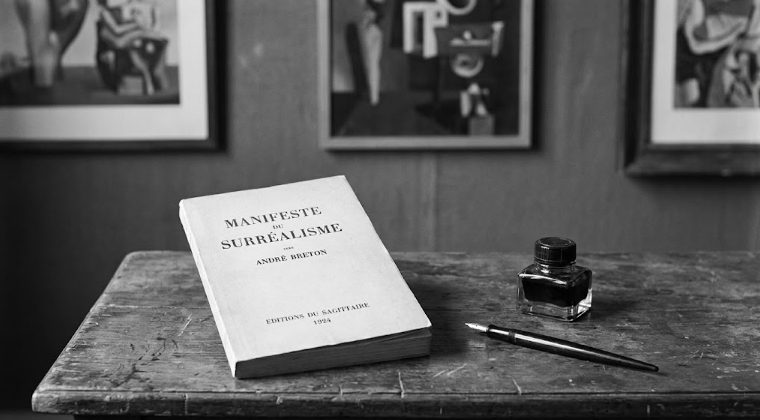
The exhibition includes an extraordinary version of André Breton’s 1924 Manifeste du surréalisme; Poisson soluble.
The significance lies partly in what happened to the volume after publication. According to MoMA’s exhibition materials, this copy was rebound in 1931 by bookbinder Paul Bonet for collector René Gaffé. It contains Breton’s annotations, additional manuscripts and a collage poem, all enclosed in a bespoke nickel-silver binding. MoMA’s exhibition press material details the role of rare and altered editions in the show.
A manifesto normally exists to transmit ideas.
This one became an object.
That transformation captures an important Surrealist instinct. The movement did not want radical thought to remain safely separated from the physical structures through which people encountered it. If Surrealism challenged conventional logic, desire and perception, why should the book carrying those ideas retain a respectable conventional form?
The unusual binding turns Breton’s text into something closer to a relic, machine or sealed device. Reading and handling become connected.
This physicality helps explain why the Surrealist book could exceed a painting’s reach. A painting generally remained tied to a gallery, private home or collection. Books circulated. They crossed borders, passed between artists, entered bedrooms and cafés, and placed experimental combinations of image and language directly into a reader’s hands.
MoMA curator Jodi Hauptman has framed the form in similar terms, arguing that the Surrealist book uniquely combined literary, artistic and political ambitions while helping Surrealist thought circulate.
The radical object could travel.
Claude Cahun Made Identity Unstable Across An Entire Volume
Claude Cahun and Marcel Moore’s 1930 Aveux non avenus—translated as Disavowals, Cancelled Confessions and other variations—shows what happened when the book itself became a laboratory for identity.
Cahun’s work is often encountered today through individual self-portraits. Removed from their original relationships, those photographs can appear as isolated experiments in costume, gender presentation or theatrical persona.
Aveux non avenus creates a more complicated experience.
MoMA describes the work as a surreal autobiographical mosaic combining personal reflection with literary and cultural references. Photomontages made collaboratively by Cahun and Moore interrupt and complicate the written material. The result resists the expectation that autobiography should clarify who its subject really is. MoMA’s Claude Cahun material identifies the book as a collaborative project in which photographic montage and fragmented writing destabilize the idea of a fixed self.
That instability is far more difficult to reproduce through one framed photograph.
A single image can show transformation.
A book can make transformation cumulative.
The reader encounters different faces, statements and visual identities over time. No final portrait has to resolve the contradictions. Turning pages becomes part of the argument: identity keeps moving because the book keeps moving.
This is one reason Surrealist publishing remains surprisingly contemporary. Modern visual culture is filled with fragmented self-presentation—profiles, image grids, avatars, captions and sequences that construct identity through accumulation rather than through a single authoritative portrait.
Cahun and Moore were working with radically different technology, yet their book already understood the psychological force of the sequence.
Max Ernst Made Reading Behave Like Dreaming
Max Ernst pushed the relationship between book and image in another direction.
His collage novels assembled images taken largely from 19th-century engravings, recombining them into sequences that appear coherent for a moment before collapsing into visual impossibility. Works such as La femme 100 têtes, published in 1929, demonstrated how printed images created for one historical purpose could be detached from their original meanings and inserted into another reality.
The Metropolitan Museum of Art preserves an edition of the work made from photomechanical reproductions of Ernst’s collages. Max Ernst’s La femme 100 têtes shows how the reproducible page became part of the artwork rather than merely a record of it.
The technique has an obvious relationship with dreams.
Dreams rarely invent every component they contain. They recombine familiar people, places, fears and objects in relationships that feel temporarily convincing.
Ernst’s books operate similarly.
Victorian interiors meet impossible creatures. Bodies merge with machinery. Respectable domestic spaces become threatening. A reader recognizes nearly every component but cannot stabilize the whole scene.
The page becomes an engine of false familiarity.
This is where books offered Surrealists something painting could not provide so easily: duration. Ernst could make one impossible image lead into another, creating visual logic through repetition and sequence. The reader does not merely observe Surrealism. The reader advances through it.
Toyen And Jindřich Heisler Turned Photography Into “Realized Poems”
One of the strongest examples in MoMA’s exhibition comes from wartime Prague.
Toyen and poet Jindřich Heisler created Z kasemat spánku: Realisované básně (From the Strongholds of Sleep: Realized Poems) in 1940. MoMA describes the rare publication as a book containing eight gelatin silver photographs of staged environments created by Toyen and Heisler, mounted on metallic paper and combined with printed text.
The term “realized poems” captures what is unusual about the project.
Poetry was no longer confined to words.
Objects could become syntax. A miniature creature could function like a metaphor. Photographic space could behave like a stanza. The page could force language and image into a relationship where neither served merely as illustration for the other.
The book was produced under extraordinary political pressure. Heisler was Jewish, and during the Nazi occupation Toyen concealed him for years in Prague. MoMA’s research into their wartime work examines those dangerous circumstances in Surrealism Against the War.
That context makes the physical book even more significant.
Surrealist publishing was not always an elegant private experiment. Under censorship, occupation and political repression, portable visual and literary forms could preserve ideas that official culture wanted controlled.
The book could hide.
The book could circulate.
The book could survive.
Collaboration Made Books More Unpredictable Than A Single Canvas
Surrealism repeatedly attacked the romantic idea that art must originate from one sovereign individual.
Automatic writing challenged deliberate authorship. The exquisite corpse distributed creation across several people. Collage depended on existing images. Photographic experiments invited accidents in the darkroom.
Books were perfectly suited to this collective logic.
MoMA’s exhibition foregrounds collaborations between poets, photographers, painters, designers and binders. Cahun worked with Moore. Toyen worked with Heisler. Breton’s manifesto became a new object through Paul Bonet’s binding. Other publications joined poems to photographic processes, printed reproductions, found imagery and unconventional materials.
A painting could certainly be collaborative, but the mythology of modern painting strongly favored the signature of the individual artist.
Books made shared authorship harder to ignore.
Someone writes.
Someone photographs.
Someone arranges.
Someone prints.
Someone binds.
The final object can belong to all of them without becoming reducible to any one contributor.
That structure matched Surrealism’s fascination with reducing conscious control. Collaborative production introduced friction and surprise. Another person’s contribution could interrupt the author’s intention in much the same way that chance interrupted an automatic drawing.
The book became a social version of the unconscious.
Paintings Became Icons, But Books Spread The Method
The difference between Surrealist paintings and Surrealist books is clearest in their later cultural reputations.
Paintings became icons.
Dalí’s melting clocks, Magritte’s bowler hats and Ernst’s strange forests can be extracted from their original contexts and reproduced endlessly. That visibility helped define the popular image of Surrealism as a style of bizarre imagery.
Books carried something less easily summarized: the method.
Their pages taught readers to accept disruption between image and text, unstable narrative, collage, collaborative authorship, nonlinear sequence and deliberate material awkwardness.
Those principles migrated far beyond explicitly Surrealist publications.
Experimental photobooks, zines, graphic novels, conceptual artists’ books and independent publishing all rely on the possibility that the form of a book can generate meaning rather than merely deliver content.
MoMA’s 2026 exhibition traces that Surrealist sensibility beyond the movement’s foundational decades and into books produced during the 1950s and 1960s. It includes later artists and writers who adapted collaboration, collage and chance as strategies for bypassing conventional thought.
That longer history helps explain the exhibition’s title.
A mirror usually offers a stable reflection.
Surrealism distrusted stability.
Put a mirror inside a book and the reflection changes each time the page moves.
Why Tomorrow Lives In Mirrors Changes The Surrealist Story
The Surrealist Book: Tomorrow Lives in Mirrors is organized by Jodi Hauptman, MoMA’s Robert Lehman Foundation Chief Curator of Drawings and Prints, and curator Starr Figura, with curatorial assistant Kolleen Ku. The exhibition opens October 4, 2026, after member previews from October 1 through October 3, and remains on view until January 23, 2027.
Its deeper importance lies in what it does to the hierarchy of Surrealist art.
Paintings remain indispensable to the movement’s history. Yet a canvas hangs still.
The Surrealist book could be hidden, carried, opened, closed, rearranged in the mind, passed between collaborators and encountered in private. It could combine photography and poetry before multimedia became an ordinary artistic category. It could make binding part of sculpture, typography part of psychology and page sequence part of narrative sabotage.
It could ask the reader to participate.
That is why calling these books more radical than paintings is not simply provocation. Their radicalism came from refusing to stay within a single medium.
Breton could turn a manifesto into an object. Cahun and Moore could make autobiography refuse a stable identity. Ernst could transform discarded engravings into dream sequences. Toyen and Heisler could make photographs function as poems.
The book held all those possibilities without needing to decide whether it was literature, photography, sculpture, graphic design or political communication.
For the Surrealists, that uncertainty was not a defect.
It was the point.
MoMA’s Tomorrow Lives in Mirrors brings that unstable object back into view at a moment when images are usually consumed as isolated, endlessly scrolling fragments. The exhibition suggests an older but strangely relevant alternative: an artwork that makes the viewer slow down, touch an object, turn a page and discover that the next image can overturn everything that came before it.
A Surrealist painting could show a dream.
A Surrealist book could teach reality to behave like one.