
Lee Miller did not need to invent impossible worlds to make reality feel surreal. A Paris street could become an architectural hallucination. A fashion model photographed during wartime could look like a figure stranded between elegance and catastrophe. A bombed building could produce an accidental composition stranger than anything constructed in a studio. By 1945, Miller was photographing scenes at Buchenwald and Dachau whose horror exceeded the nightmare logic that Surrealist artists had explored two decades earlier.
That continuity is receiving renewed attention in 2026. The Art Institute of Chicago opens Lee Miller: Fearless on August 29, 2026, where it remains on view through December 7. The museum describes the exhibition as the first comprehensive survey of Miller’s photography in more than 25 years. Organized with Tate Britain and the Musée d’Art Moderne de Paris, it follows Miller across fashion, Surrealism, portraiture and war photography rather than reducing her to the familiar label of Man Ray’s model and muse. The Art Institute’s Lee Miller retrospective makes a stronger proposition: Miller’s restless way of seeing connected apparently incompatible stages of her career.
That is where Miller becomes especially important to Surrealism. Many Surrealists built pictures that resembled dreams. Miller repeatedly turned her camera toward ordinary or historical reality and showed that the waking world could already be stranger, more unstable and more disturbing than one.
Paris Taught Miller To Distrust An Ordinary Photograph
Elizabeth “Lee” Miller was born in Poughkeepsie, New York, on April 23, 1907. She first became prominent in front of the camera as a fashion model in New York, working with major photographers of the period. Her ambitions soon shifted behind the lens.
In 1929, Miller moved to Paris and entered the orbit of Man Ray. Their personal and artistic partnership connected her directly to the Surrealist avant-garde, yet describing Miller merely as his assistant obscures how quickly she developed an independent practice. She opened her own Paris photography studio in 1930 and worked in portraiture, fashion and experimental photography.
The Lee Miller Archives describes this period as the point at which Miller moved decisively from being photographed to making photographs. It was in Paris that Miller and Man Ray developed work using the Sabatier effect, more commonly called solarization: partial reversal of tones during photographic processing creates luminous outlines and strange separations between light and dark. The Lee Miller Archives biography records how this technical accident became part of Miller’s Surrealist vocabulary.
Solarization suited Surrealism precisely because it could make a recognizable body or object look simultaneously real and impossible.
Yet Miller’s greatest Surrealist insight went further than technique.
She learned that a photographer could destabilize reality through framing, rotation, cropping and attention. There was no need to construct a dream scene when the city itself contained accidental visual riddles.
Impasse Des Deux Anges Turns A Street Into A Psychological Trap
Few photographs explain Miller’s method better than Impasse des Deux Anges, made around 1931.
The original subject is mundane: a Parisian street beneath overpasses. Miller solarized the photograph and rotated the resulting image. The Metropolitan Museum of Art notes that these decisions transform an ordinary urban environment into something resembling a disorienting hall of mirrors. Solid architecture ceases to behave rationally. Columns, openings and empty spaces exchange visual roles.
The Met’s collection record for Impasse des Deux Anges provides a concise example of how Miller altered perception without abandoning photography’s relationship to the physical world.
This is a crucial difference between Miller’s Surrealism and the popular idea of Surrealism as painted fantasy.
The photograph begins with something that existed.
The strange world comes from seeing it differently.
Miller’s camera refuses to accept the first interpretation of a place. A wall can become a void. An opening can feel solid. Orientation can become unreliable. The viewer knows the image originates in reality yet cannot easily reconstruct that reality.
That tension is one of photography’s strongest contributions to Surrealism. A painting can openly announce that its impossible scene has been invented. A photograph carries a lingering expectation of evidence. Miller exploited that expectation.
The image says: this existed.
Its appearance says: this cannot exist.
That contradiction gives Miller’s early photographs their unsettling force.
Readers exploring the broader relationship between camera-based imagery and the movement can place Miller within thesurrealists.org’s analysis of Surrealism’s influence on photography, where techniques such as solarization, unusual framing and visual ambiguity show how photographers disrupted the medium’s reputation for straightforward documentation.
Egypt Showed Her That Strangeness Did Not Require A Studio
Miller left Paris for New York in 1932 and established another successful studio. Her life changed direction again after marrying Egyptian businessman Aziz Eloui Bey and moving to Cairo in the mid-1930s.
The Egyptian period freed Miller from the commercial demands of studio photography. She began photographing landscapes, architecture and desert environments for herself.
The shift mattered.
Surrealism no longer depended on darkroom experimentation or collaboration with a Parisian artistic circle. Miller could discover unsettling visual relationships in the external world: empty spaces, isolated structures, unexpected apertures and landscapes stripped of familiar scale.
That way of seeing became portable.
It is tempting to divide Miller’s career into separate identities—model, Surrealist, fashion photographer, traveler, war correspondent. The current museum reassessment makes those categories look increasingly artificial. The Musée d’Art Moderne de Paris presented approximately 250 vintage and modern prints in its 2026 retrospective, explicitly tracing Miller’s career from New York and Paris through Egypt, London and wartime Europe. The Paris presentation, which ran from April 10 to August 2, 2026, was the largest French retrospective devoted to her in 20 years. Its Lee Miller exhibition overview stresses the coexistence of formal experimentation and political engagement across her work.
The same eye kept moving through radically different circumstances.
What changed was the world in front of it.
Wartime Fashion Made Elegance Look Unstable
Miller settled in London with British Surrealist Roland Penrose shortly before the Second World War. She began working for British Vogue, where fashion photography existed against blackouts, rationing, bomb damage and the psychological pressure of war.
This setting could have destroyed the visual language Miller developed around Surrealism.
Instead, it gave that language a new reality.
Fashion photographs made during wartime contain unavoidable contradictions. Clothing represents design, aspiration and beauty; the surrounding city may bear evidence of destruction. Bodies remain carefully composed at a moment when ordinary civilian life is precarious.
Miller could make those contradictions visible without turning every photograph into propaganda.
A damaged urban environment provided unexpected forms. Broken architecture created frames, voids and fractured perspectives. Everyday wartime objects could become uncanny through isolation. The polished codes of fashion existed beside physical evidence that Europe’s social order had been violently disrupted.
The Lee Miller Archives continues to document this transition through exhibitions that connect her prewar Surrealist beach photography with the wartime landscapes she later photographed using the same cameras. Its Beach to Beachhead project explicitly follows the transformation of beaches from spaces of friendship and artistic experimentation into fortified landscapes marked by occupation and conflict.
For Miller, reality had begun performing its own Surrealist transformations.
The War Made Surrealist Dislocation Terrifyingly Literal
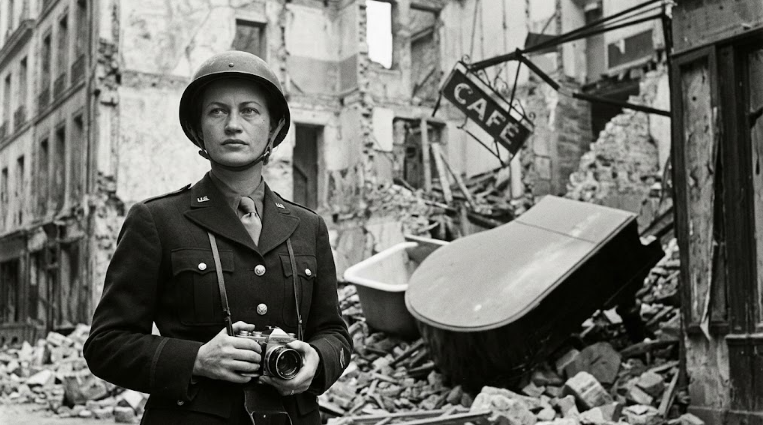
In 1944, Miller became a war correspondent accredited to the U.S. Army and followed Allied forces through Europe for Vogue. She photographed the siege of Saint-Malo, the liberation of Paris, fighting in Luxembourg and Alsace, and the meeting of American and Soviet forces at Torgau.
Then she entered Buchenwald and Dachau.
The distinction between Surrealist nightmare and historical documentation becomes ethically significant at this point.
Miller did not need to make atrocity look strange. The events themselves had ruptured ordinary categories of comprehension. Her responsibility was no longer to transform reality into an imaginative puzzle. It was to record evidence without making horror aesthetically comfortable.
The Lee Miller Archives documents her presence at the liberation of both camps and her subsequent journey through Germany. Its account of Miller’s wartime work records the extraordinary geographical range of her assignments and the psychological impact of what she witnessed.
This stage of Miller’s career changes how her earlier Surrealism can be read.
During the 1930s, distortion exposed hidden possibilities inside ordinary reality. In 1945, history itself had become grotesquely distorted.
Miller’s camera remained exact.
That fact separates the photographs from fantasy.
Hitler’s Bathtub Became A Surrealist Image Made By History
One of the most discussed photographs associated with Miller’s wartime career was taken in Adolf Hitler’s Munich apartment on April 30, 1945, the day Hitler died in Berlin.
Miller and LIFE photographer David E. Scherman had arrived in Munich after documenting Dachau. Scherman photographed Miller sitting in Hitler’s bathtub. Her dirty combat boots appear on the bathmat; a portrait of Hitler sits beside the tub.
The image can look staged, theatrical and almost absurd.
Its meaning comes from its historical sequence.
Miller had carried the physical dirt of Dachau into Hitler’s private residence. The collision between concentration-camp evidence, domestic luxury, military presence and the dictator’s carefully controlled image creates something more disorienting than an invented Surrealist tableau.
The Lee Miller Archives interprets the bath as an act charged with Miller’s anger and disgust after the camps. Its account of Miller’s journey through liberated Europe places the photograph within the events she witnessed rather than treating it as a glamorous celebrity image.
Here, Miller’s career reaches an extraordinary visual paradox.
A photograph can be documentary and symbolic at the same time.
Nothing in the room needs to become physically impossible. The historical relationship between its objects already feels impossible: Hitler’s portrait, Miller’s boots, the bathtub and the knowledge of Dachau existing in a single frame of reference.
Surrealism often produced meaning through irrational juxtaposition.
History had supplied Miller with the juxtaposition.
Lee Miller: Fearless Reframes Her As The Author Of The Image
The current wave of museum exhibitions matters partly because Miller’s reputation has long been trapped inside another person’s biography.
Calling her “Man Ray’s muse” may be historically relevant, yet it reverses the direction of authorship. It asks viewers to see Miller as someone who inspired important photographs before seeing her as someone who made important photographs.
The 2025–2026 exhibition cycle has pushed against that reduction.
Tate Britain presented the retrospective from October 2, 2025, through February 15, 2026. The Musée d’Art Moderne de Paris followed from April through August 2026. The Art Institute of Chicago becomes the next venue on August 29. Paris described Miller as a major figure of the international avant-garde whose career encompassed Surrealist experimentation, portraiture, fashion and accredited war correspondence.
Chicago goes further by framing the exhibition around fearlessness across her career.
That framing makes sense when Miller’s photographic practice is considered as one continuous act of looking.
She repeatedly entered situations where conventional vision was inadequate. Paris taught her to distrust surface appearances. Egypt taught her to recognize strange structures in open landscapes. Wartime London forced fashion into dialogue with destruction. Europe in 1944 and 1945 demanded that photography confront realities people might resist believing.
The subjects changed.
The refusal to look conventionally did not.
Why Miller’s Reality Can Feel Stranger Than A Dream
Dream images release the artist from physical probability. Lee Miller discovered something more disturbing: probability does not protect reality from becoming bizarre.
A city can reorganize itself through a camera angle. A familiar body can become luminous through solarization. A beach associated with friendship can become a military position. A fashion photograph can contain the shadow of war. A dictator’s bathroom can become a stage for historical reckoning. A concentration camp can confront a photographer with facts that look beyond imagination precisely because they are facts.
That progression makes Miller one of the most revealing photographers connected to Surrealism.
She did not abandon Surrealist perception when she moved into documentary work. She learned where its limits had to change.
The early camera searched reality for instability.
The wartime camera encountered instability as history.
When Lee Miller: Fearless opens in Chicago on August 29, 2026, the exhibition will give viewers an opportunity to see those phases together rather than as disconnected careers. That matters more than another restoration of a neglected artist’s reputation.
Miller’s photographs pose a harder question about Surrealism itself.
What happens when the real world becomes stranger than anything the unconscious can invent?
Lee Miller kept photographing.