
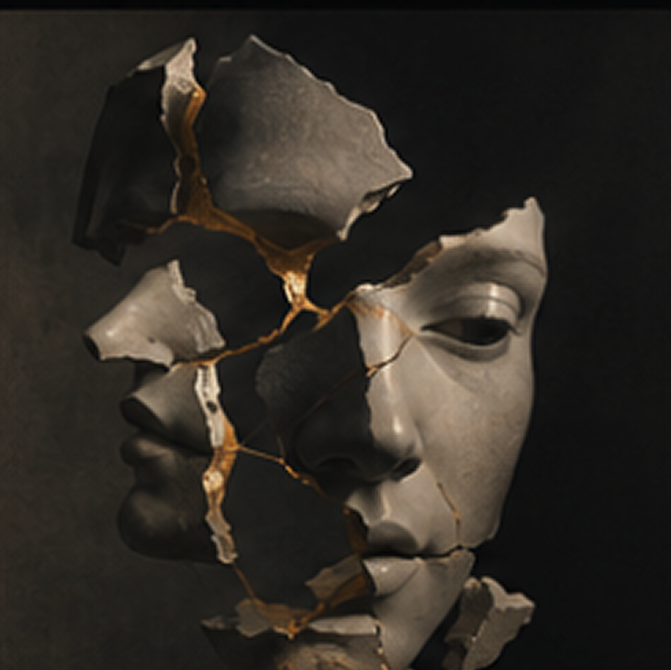
Surrealism started in the early 20th century as a bold art movement. It aimed to go beyond everyday reality. Artists explored the subconscious, creating worlds unseen by the naked eye.
The first Surrealist Manifesto was written by André Breton in 1924. It set the movement’s main goals. These included freeing thought and embracing dreams.
At the core of Surrealism is dreamlike art. These scenes are full of wonder and defy logic. They pull viewers into a world where feelings and imagination are everything.
Artists were inspired by Sigmund Freud and Carl Jung. They used the unconscious mind to create their art.
A big event, “Dreamworld: Surrealism at 100,” will open at the Philadelphia Museum of Art. It will run from November 8, 2025, to February 16, 2026. This marks a big celebration of surrealism’s 100th year. It’s a chance to see the dreamlike art that has captivated people for a century.
Key Artists and Their Works
The art of surrealist landscapes is shaped by the creative minds of its key artists. These visionaries have built worlds that make us question reality and spark wonder. Salvador Dalí is a standout, known for his painting “The Persistence of Memory”. It shows melting clocks in a dreamlike setting, symbolizing time’s fluidity in our minds.
René Magritte also made a significant impact. His piece, “The Treachery of Images”, features a pipe with the caption “Ceci n’est pas une pipe.” It makes us think about what’s real and what’s not. Magritte’s work often places everyday objects in strange settings, creating visual puzzles.
Max Ernst brought new techniques to surrealist art, like frottage and collage. His painting, “Two Children Are Threatened by a Nightingale”, shows the emotional depth and dreamlike quality of his work. Ernst’s landscapes are full of texture and chance, creating captivating scenes.
Other notable artists include Giorgio de Chirico, who started the surrealist exploration of space. Joan Miró created whimsical, abstract landscapes. Dorothea Tanning mixed the familiar with the strange in her work.
The Philadelphia Museum of Art is key in preserving these artists’ legacies. It houses important works by Marcel Duchamp and others. This museum is a treasure trove for surrealist landscapes, showing the connection between these artists.
| Artist | Notable Work | Contribution to Surrealism |
|---|---|---|
| Salvador Dalí | The Persistence of Memory | Exploration of time and reality |
| René Magritte | The Treachery of Images | Challenge to perception and representation |
| Max Ernst | Two Children Are Threatened by a Nightingale | Innovation in technique and emotional depth |
| Giorgio de Chirico | Melancholy and Mystery of a Street | Foundation of surrealist spatial concepts |
| Joan Miró | The Tilled Field | Whimsical abstraction and biomorphism |
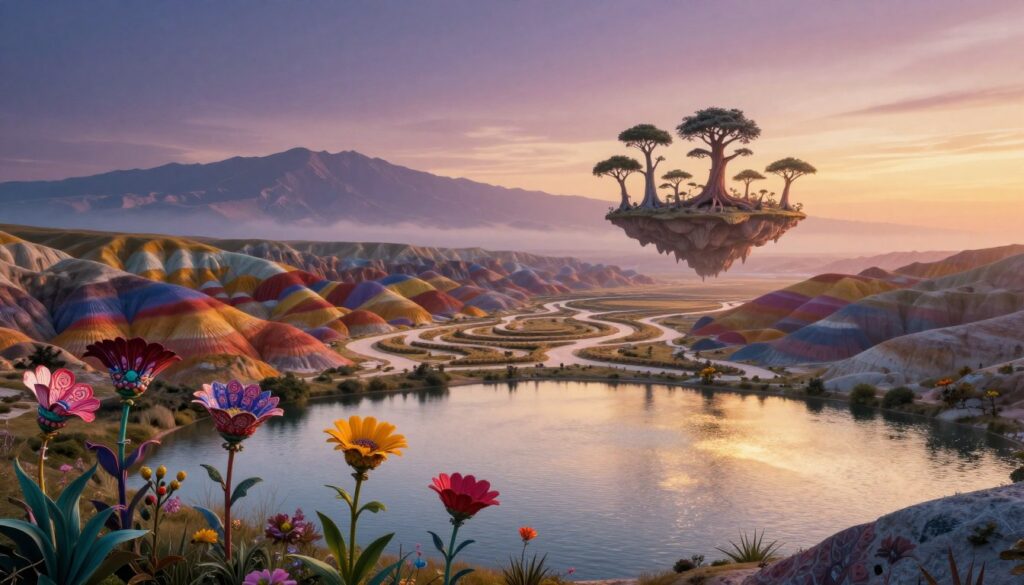
Elements Defining Surrealist Landscapes
Surrealist landscapes are filled with dreamlike elements. These features make the art feel like a dream. Automatic writing is a key technique. It lets artists tap into their subconscious, creating raw and spontaneous images.
Juxtaposition is another important element. Artists put unrelated objects together, creating striking contrasts. For example, imagine a lobster telephone or a castle floating in the sky. These images challenge our perceptions and make us think.
Dream imagery is also vital. Artists often use their dreams as inspiration. They create bizarre scenarios and impossible buildings. This shows the human psyche in a unique way, using distorted forms and bright colors.
Collage and assemblage add depth to surrealist art. Artists like Max Ernst and Joseph Cornell use found objects to create three-dimensional worlds. These worlds pull viewers into alternate realities, making the art more immersive.
Techniques like frottage and grattage add spontaneity and texture. These methods, along with themes in exhibitions like the PMA’s, show how surrealist art evolves. Each period brings new elements to the movement.
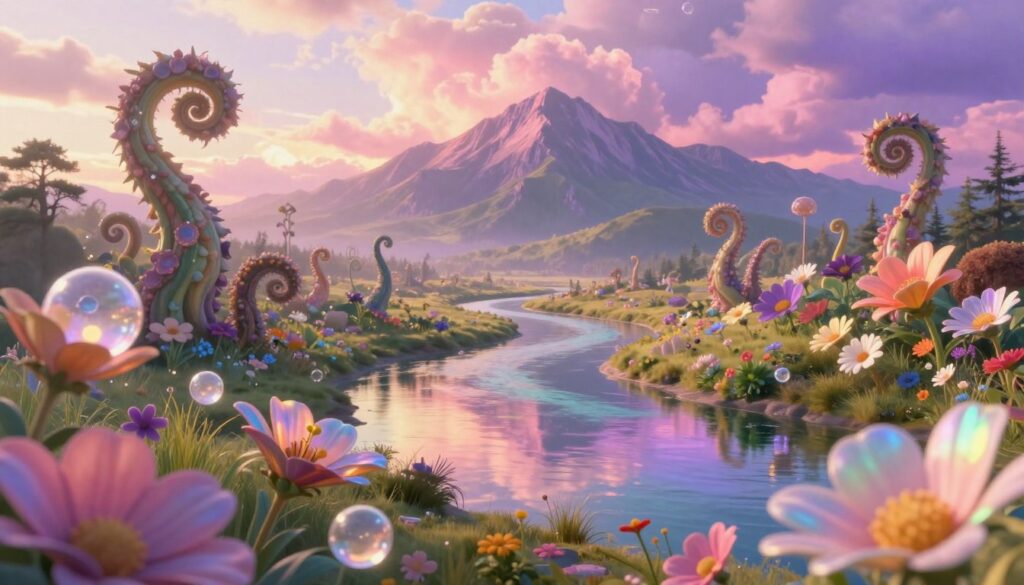
Impact on Modern Art
Surrealist landscapes have deeply influenced modern art. They challenge our views of reality and inspire many artists today. These dreamlike scenes push the limits of what we think is real.
Many artists, from painters to sculptors, find inspiration in surrealist ideas. They use unexpected combinations and vivid images in their work. For example, Yayoi Kusama’s infinity rooms and Damien Hirst’s explorations of life and death show the lasting impact of surrealism.
In movies, directors like David Lynch and Guillermo del Toro create dreamlike worlds. Films like Mulholland Drive and Eraserhead use dream logic, much like early surrealist films. These movies mix reality with fantasy, just like del Toro’s Pan’s Labyrinth.
Books have also been influenced by surrealist landscapes. Authors like Haruki Murakami and Margaret Atwood use surreal elements in their stories. They make ordinary characters face impossible situations, blurring the lines between reality and fantasy.
The digital world has opened new ways for artists to express themselves. They use 3D rendering, virtual reality, and AI to create new worlds. This technology keeps pushing the limits of what surrealism can be.
During World War II, surrealist artists like André Breton and Max Ernst moved to the Americas. They brought their ideas with them. The “Exiles” section of the PMA exhibition shows how these ideas influenced American artists.
In New York, the wartime surrealist capital, artists like Jackson Pollock and Mark Rothko were influenced. They used surrealist methods in their work, laying the groundwork for Abstract Expressionism. This shows how surrealist landscapes continue to inspire artists through the years.
| Artistic Domain | Key Influences | Notable Artists |
|---|---|---|
| Visual Arts | Immersive environments, dreamlike imagery | Yayoi Kusama, Damien Hirst |
| Cinema | Dream logic, blurred realities | David Lynch, Guillermo del Toro |
| Literature | Surreal narratives, impossible scenarios | Haruki Murakami, Margaret Atwood |
| Digital Art | 3D rendering, virtual reality | Various contemporary artists |
Analysis of Selected Artworks
Surrealist art is mesmerizing, taking us into the world of dreams. Salvador Dalí’s “The Persistence of Memory” is a prime example. It shows a world where time bends and melts, challenging our view of reality.
René Magritte’s “The Lovers” adds another layer of mystery. It depicts two figures trying to connect, but they’re hidden by fabric. This piece highlights the struggle between our desires and what society expects of us.
Max Ernst’s “Two Children Are Threatened by a Nightingale” is a mix of fantasy and fear. It takes place in a peaceful setting but is disrupted by a dark presence. This work shows the complex nature of our minds.
Women artists like Leonora Carrington and Remedios Varo also made a big impact. Carrington’s “The Pleasures of Dagobert” shows magical changes, while Varo’s “Creation of the Birds” blends myth and reality. Frida Kahlo’s “My Grandparents, My Parents, and I” uses surrealist techniques to explore her identity.
These works show the heart of the surrealist movement: creativity and innovation. For more on surrealist photography, check out this resource. Each piece encourages us to explore our own subconscious, inspiring artists and fans.