
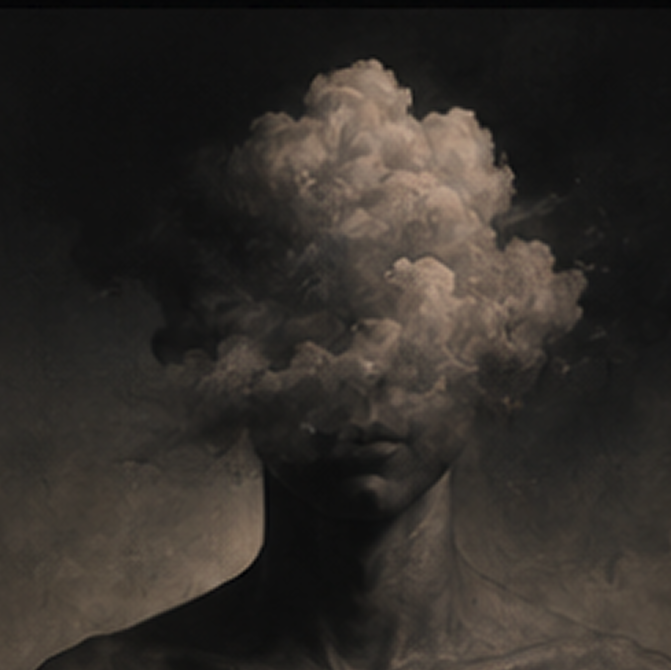
Surrealism started in Paris in the 1920s, changing the art world forever. André Breton founded it with his 1924 Surrealist Manifesto. This movement aimed to unlock the power of the unconscious mind.
It wanted to break free from traditional art by embracing dreams and the irrational. The term “surrealist” was first used by Guillaume Apollinaire in 1917. This set the stage for a new era of creativity.
This movement grew from Dada, a response to World War I’s chaos. It was influenced by Sigmund Freud and Karl Marx‘s ideas on the mind.
Artists like Max Ernst, Salvador Dalí, and René Magritte were key. They brought dreamlike images into art, captivating people to this day. The Bureau for Surrealist Research was set up in 1924, showing the movement’s deep dive into human imagination.
As Europe faced turmoil in the 1930s and 1940s, surrealism spread worldwide. It inspired artists in the Americas. This introduction prepares us to explore the art icons who shaped this movement.
Distinctive Styles and Techniques
The art of surrealist painters is unique. They use special techniques to explore the mind. These methods show their creative process and the deep themes in their work. Let’s look at the three main techniques that make this movement so fascinating.
Automatism and the Unconscious Mind
Automatism is key in surrealist art. It lets artists skip rational thinking and dive into their subconscious. André Masson started this by creating without thinking.
Through automatic drawing and writing, artists express their true thoughts and feelings. This way, they connect with their inner self, leading to unique and surprising results.
Dream Imagery and Hidden Symbolism
Dreams are a big source of inspiration for surrealist painters. They use dreams to add hidden symbols to their work. This makes their art rich with meaning, inviting viewers to explore.
Birds, Clocks, and Windows as Recurring Motifs
Birds, clocks, and windows often appear in surrealist art. Max Ernst saw birds as symbols of self and death. Salvador Dalí’s melting clocks in “The Persistence of Memory” question our view of time.
René Magritte’s windows in “Time Transfixed” play tricks on our eyes. These motifs add depth and surprise to surrealist art.
Juxtaposition and the Uncanny
Juxtaposition is a technique that puts different things together. It creates an uncanny effect. This method shows the oddness of reality and makes us question what we see.
The Object Trouvé and Bizarre Assemblages
The object trouvé, or found object, is used by artists like Eileen Agar and Paul Nash. They find everyday items, like beach flotsam, to make strange sculptures. These pieces turn normal things into amazing visual statements, showing the surrealist love for recontextualization.
Influence on Modern Art
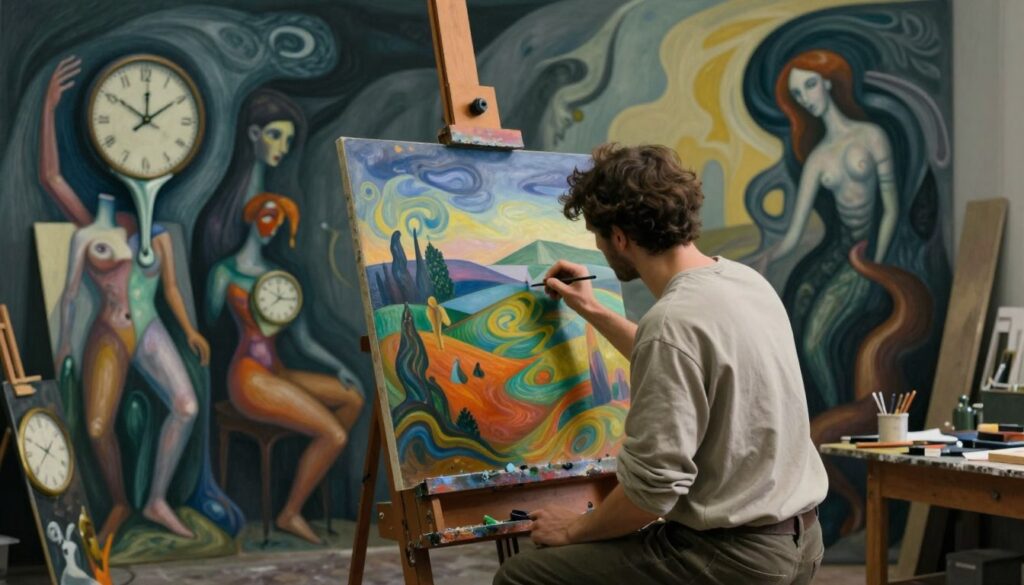
Surrealist painters have left a lasting mark on modern art. Their bold ideas and techniques have changed the art world, mainly in the United States. This section looks at how surrealism led to movements like Abstract Expressionism. It also highlights key figures and exhibitions that connected these art styles.
From Dada Rebellion to Abstract Expressionism
Surrealism grew out of Dadaism, which rejected traditional art rules. This move towards the unconscious mind paved the way for new art forms. Jackson Pollock, a key figure in Abstract Expressionism, was inspired by surrealist automatism.
His drip paintings, with their chaotic yet controlled movements, show deep subconscious expression.
Jackson Pollock and the Drip Paintings
Pollock poured and dripped paint on canvases laid flat on the ground. This method let him embrace spontaneity and the subconscious, following surrealist ideas. His work changed painting and made viewers rethink what art is.
The freedom in Pollock’s art became a key part of the Abstract Expressionist movement.
The New York School and Peggy Guggenheim’s 1942 Exhibition
During World War II, the art scene moved to New York. Peggy Guggenheim was key in showing surrealist art. Her 1942 exhibition featured American artists like Mark Rothko and Robert Motherwell, influenced by surrealism.
This show brought together American and European artists, enriching the art scene.
Rothko, Motherwell, and the European Connection
Rothko and Motherwell, influenced by surrealism, explored emotions and abstraction. Their works, alongside European surrealists like Joan Miró and André Masson, showed the connection between art movements. This blending made New York a new hub for modern art.
Feminist Revisions and Women Surrealists
Feminist art historians have looked at women’s roles in surrealism. Artists like Leonora Carrington, Dorothea Tanning, and Claude Cahun challenged the male-dominated movement. Their works explored identity, gender, and mythology, giving surrealism a fresh perspective.
Leonora Carrington, Dorothea Tanning, and Claude Cahun
These women used surrealism to express their unique experiences. Carrington’s mythic self-portraits and Tanning’s dreamlike images challenged traditional views of women. Cahun’s cross-dressing and animal depictions questioned societal norms, allowing these artists to reclaim their stories and assert their identities.
| Artist | Key Work | Contribution |
|---|---|---|
| Jackson Pollock | Number 1, 1950 | Innovated drip painting technique |
| Mark Rothko | Orange and Yellow | Explored emotional depth through color |
| Leonora Carrington | The Lovers | Challenged gender norms in surrealism |
| Dorothea Tanning | Birthday | Explored dreamlike themes and identity |
| Claude Cahun | Self-Portrait | Questioned gender identity and representation |
Selected Works and Analysis
Iconic surrealist painters have created a world full of themes and techniques. Their works show complex emotions and challenge our view of reality. We’ll look at four famous surrealist painters and their unique contributions to art.
Salvador Dalí’s Dreamscapes
Dalí’s art is a deep dive into dreams and the subconscious. His paintings take us into a world where dreams and reality mix.
Dream Caused by the Flight of a Bee and Lobster Telephone
In Dream Caused by the Flight of a Bee around a Pomegranate a Second before Awakening (1944), Dalí shows the moment between sleep and wakefulness. It’s a mix of urgency and surreal beauty.
His Lobster Telephone (1938) is a bold statement on sexuality and desire. It combines the ordinary with the strange.
René Magritte’s Optical Illusions
Magritte’s art makes us think differently about reality. He uses clever visual tricks to do this.
Time Transfixed and the Treachery of Images
His Time Transfixed (1938), originally La durée poignardée, shows a steam train coming out of a fireplace. It challenges our understanding of time and space.
In The Treachery of Images (1929), Magritte says, “Ceci n’est pas une pipe” (This is not a pipe). He questions how we see things.
Leonora Carrington’s Mythic Self-Portraits
Carrington’s work is filled with mythology and her own identity.
Self-Portrait (1937-38) and the Equine Spirit
In her Self-Portrait (1937-38), Carrington shows herself in a sterile room. But a wild white horse represents her free spirit. This shows her fight between society’s expectations and her own freedom.
Max Ernst’s Avian Symbolism
Ernst’s art often uses birds. They symbolize both personal struggles and big existential themes.
Two Children Are Threatened by a Nightingale and The Barbarians
In Two Children Are Threatened by a Nightingale (1924), birds represent both the self and death. This theme is also seen in The Barbarians (1937). It shows Ernst’s deep fears and experiences.
| Artist | Work | Year | Theme |
|---|---|---|---|
| Salvador Dalí | Dream Caused by the Flight of a Bee | 1944 | Dreams and Consciousness |
| Salvador Dalí | Lobster Telephone | 1938 | Sexuality and Desire |
| René Magritte | Time Transfixed | 1938 | Time and Reality |
| Leonora Carrington | Self-Portrait | 1937-38 | Identity and Freedom |
| Max Ernst | Two Children Are Threatened by a Nightingale | 1924 | Trauma and Existence |
Legacy in Contemporary Art
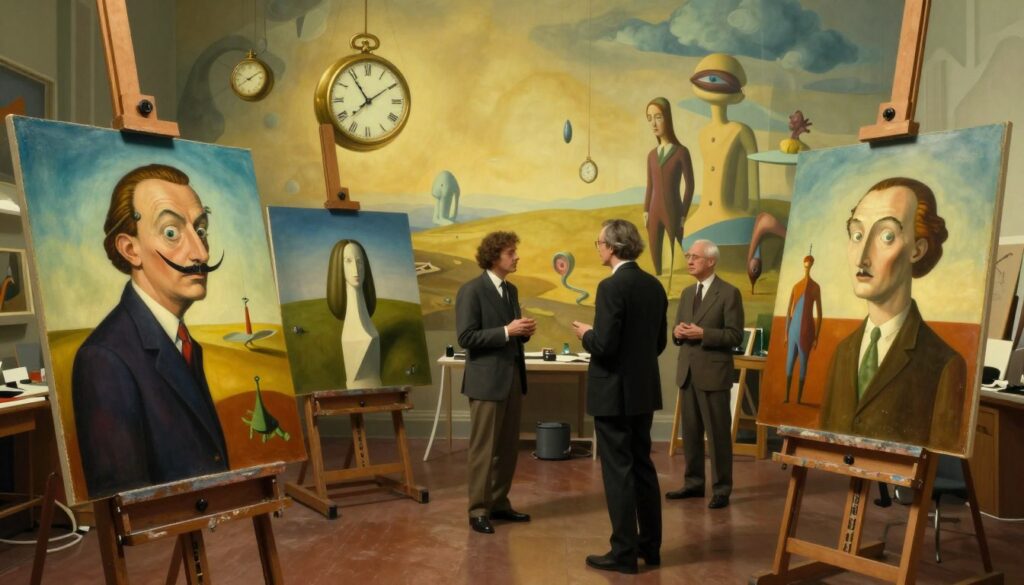
Surrealism’s impact is seen in today’s art, showing its lasting influence. The 2022 show “Surrealism Beyond Borders” at Tate Modern showed its global reach. Artists like Toshiko Okanoue, with “The Call” (1953), use striking images to talk about being trapped and nature’s power.
These works show how Surrealism crosses cultural lines, becoming a universal way to express.
Surrealism Beyond Borders at Tate Modern
Okanoue’s photomontages make us think about deep feelings and big issues. This show made Surrealism seem like a global movement, showing its effect on many cultures. It shows how Surrealism can connect with people all over, making it a key art icon.
British Surrealism’s Enduring Impact
British artists like Eileen Agar and Paul Nash were key in shaping Surrealism in Britain. Their work was highlighted after the 1936 International Surrealist Exhibition in London. Agar used found objects and Nash looked at landscapes in a new way, showing a British take on Surrealism.
Eileen Agar, Paul Nash, and the 1936 International Exhibition
This exhibition sparked the British Surrealist movement, inspiring creativity that affects artists today. It focused on imagination and the natural world, themes that are important in today’s art.
Contemporary Artists Inspired by Surrealism
Today’s artists are inspired by Surrealism’s ideas. They use techniques like automatism and dream images to explore the human mind. They work in many ways, from installations to digital art, to challenge old ideas.
The Ongoing Relevance of Dream and Unconscious Imagery
Surrealism’s focus on the unconscious mind is a powerful tool for today’s artists. This connection between past and present keeps Surrealism alive and growing in the art world. For more on these art icons, check out TheSurrealists.org.