
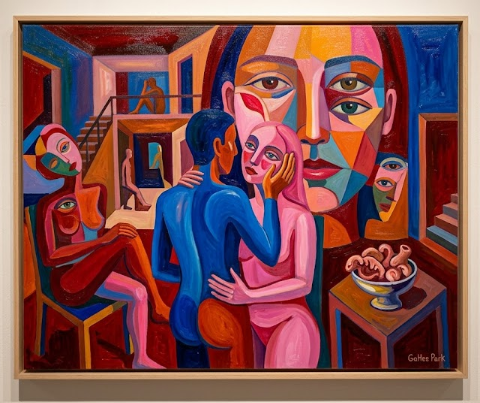
GaHee Park: Behind the Curtain turns private rooms into surreal confessions because it treats domestic space as a place where fantasy, sexuality, mortality, identity, and alienation quietly break through the surface. On view at Yerba Buena Center for the Arts in San Francisco from August 7, 2026, to January 3, 2027, the exhibition presents recent paintings by GaHee Park, the Seoul-born, Montreal-based artist whose interiors make ordinary objects feel psychologically charged.
For thesurrealists.org, the exhibition matters because Park’s rooms are not neutral settings. Curtains, tablecloths, blankets, cocktail glasses, insects, snails, sardines, fingernails, shadows, women, and seaside landscapes become clues inside a private visual drama. Her paintings do not simply show domestic solitude. They make solitude feel like a confession the viewer has entered too late, or perhaps too eagerly.
The official YBCA exhibition page describes Behind the Curtain as an exhibition of recent paintings that explore fantasy, sexuality, and mortality through ambiguous depictions of private moments. Curated by Dorothy Dávila, the exhibition is Park’s inaugural solo institutional exhibition in the United States and appears in YBCA’s Second Floor Galleries. That institutional first gives the show its news value, but the deeper reason it belongs in a Surrealist conversation is the way Park turns interior space into an unstable theater of desire.
Why “Behind The Curtain” Feels So Current
The timing of Behind the Curtain is useful because contemporary art audiences are again drawn to painting that feels intimate, figurative, psychologically complicated, and resistant to easy explanation. Park’s work fits that moment without becoming fashionable in a shallow way. Her paintings are figurative, but not simply narrative. They are erotic, but not merely provocative. They are domestic, but not cozy. They are surreal, but not dependent on familiar historical clichés.
YBCA’s press release for the exhibition states that Behind the Curtain spans the last five years of Park’s practice. That time frame matters because it positions the show as a concentrated look at her recent development rather than a broad career survey. the show as a concentrated look at her recent development It also lets viewers see how consistently Park has returned to interior scenes where the boundary between body, object, room, and landscape refuses to stay fixed.
The exhibition opened on August 7, 2026, only days before this article’s publication date, which makes it a fresh subject for readers interested in contemporary Surrealist painting. It is also not a distant European museum event or a historical retrospective. It is a live U.S. institutional exhibition by an artist working now, using painting to reframe desire, looking, domesticity, and psychological interior life.
That is why the topic feels strong for thesurrealists.org. Park’s work offers a contemporary answer to an old Surrealist question: what happens when the private room stops behaving like a private room and becomes a stage for the unconscious?
How GaHee Park Turns Domestic Space Into A Stage
Park’s rooms are often filled with ordinary domestic materials: curtains, tables, blankets, glasses, dishes, fabrics, windows, and decorative surfaces. Yet these materials rarely behave as background details. They press forward. They become active agents in the image. A curtain does not simply cover a window. It suggests concealment, theatricality, voyeurism, and the promise of revelation.
That is why the exhibition title Behind the Curtain works so well. The phrase carries several meanings at once. It suggests the private world hidden from public view. It suggests theater, where the curtain separates audience from performance. It suggests erotic disclosure, where looking is both invited and troubled. It also suggests painting itself, where the surface hides the psychological machinery underneath.
YBCA notes that much of Park’s work transforms intimate spaces into fantastical ones, using domestic references such as curtains, tablecloths, and blankets that fuse body and landscape. That fusion is crucial. In Park’s paintings, the body does not sit inside the room as a separate subject. The body and room begin to contaminate each other.
This is where the art becomes surreal. The most unsettling thing in Park’s paintings is not that strange objects appear. It is that ordinary things appear to know too much. A cocktail glass, a cat’s water bowl, a shadow, or an insect can become a psychological device. The room confesses because every object seems implicated.
Why Park’s Private Moments Feel Like Confessions
A confession usually implies speech, but Park’s paintings rarely need direct speech. Their confessional quality comes from posture, framing, stillness, and withheld information. The figures often appear alone, absorbed, or indirectly watched. They may gaze at fingernails, peer into glasses, recline, or sit inside rooms that feel both beautiful and slightly wrong.
The viewer is placed in a delicate position. Park invites looking, then makes looking uncomfortable. The image may offer access to an intimate scene, but it also asks why the viewer wants that access. This is one reason the work feels psychologically rich. It does not only depict private life. It implicates the act of looking at private life.
YBCA’s press materials say Park’s work subverts the viewer’s gaze and shifts female subjects into a role of quiet power. That point is important because the paintings are not simply about exposure. They are also about control. Park’s women may appear vulnerable, but they are not passive. The paintings often seem aware of the viewer before the viewer can fully possess the scene.
This is what makes the rooms feel like confessions rather than voyeuristic trophies. A confession is never only disclosure. It is also a performance of power: the speaker decides what to reveal, what to withhold, and how the listener will be made to feel.
How Fantasy, Sexuality, And Mortality Meet
The official YBCA framing identifies fantasy, sexuality, and mortality as core themes of Behind the Curtain. Those themes are not separate compartments in Park’s work. They overlap through objects, bodies, food, insects, reflections, and theatrical interiors.
Sexuality appears not only through bodies but through atmosphere. A curtain partly drawn, a figure reclining, a glass held close, a shadow face, or an object placed too deliberately can suggest desire without turning the painting into a simple erotic scene. Fantasy appears through spatial uncertainty and symbolic distortion. Mortality appears through still-life traditions, insects, vanitas-like details, and the sense that pleasure is always temporary.
That last point is especially important. YBCA connects Park’s art to seventeenth-century Dutch still-life painting, a tradition often associated with abundance, pleasure, time, decay, and moral reflection. In Park’s hands, still life becomes intimate and unsettled. Objects do not merely show taste or wealth. They become signs of appetite, passing time, bodily vulnerability, and the uneasy closeness between pleasure and disappearance.
This connects naturally with thesurrealists.org’s earlier discussion of symbolism in Surrealist art, because Park’s symbols do not work like fixed codes. A glass, insect, curtain, or sardine does not mean one thing. It gathers emotional pressure until the room itself begins to feel alive.
Why The Female Gaze Holds Power Here
The most important political shift in Park’s work may be its treatment of looking. Many art-historical traditions have placed women inside paintings as objects of desire, allegory, beauty, or possession. Park knows that history, but she does not simply reject it. She enters it, bends it, and makes it reveal its contradictions.
The Jessica Silverman artist page for GaHee Park describes her scenes as deeply psychological and notes that her female nude becomes a psychologically complex feminist subject rather than a passive sex object. That distinction helps explain why Park’s paintings can be erotic without surrendering their subjects to the viewer.
Her figures often seem half-withdrawn and half-aware. They do not always confront the viewer directly, but the paintings still feel controlled by their presence. Even when a woman appears alone, she is not simply available. The room seems organized around her interiority.
This is why the title Behind the Curtain also suggests authorship. Park is not only painting scenes of private life. She is pulling the curtain on the mechanisms that made female privacy, female bodies, and female desire into spectacles. The paintings ask what happens when the spectacle begins to look back.
How “Thoughts At Dusk” Turns Time Into A Surreal Room
YBCA’s press release names Thoughts at Dusk, a 2024 work, as an example of Park’s temporal instability. The painting places a subject within a yellow sunset, creating a transitional moment where past, present, and future collide. That description is useful because it shows how Park’s surrealism works through time as much as space.
Dusk is already a threshold. It is neither day nor night, neither public productivity nor private sleep. In a painting about interior life, dusk becomes psychological weather. It can hold memory, desire, anticipation, and unease in one suspended light.
YBCA notes that objects such as a martini glass and a cat’s water bowl magnify and refract physical and immaterial forms in Thoughts at Dusk. This is exactly the kind of detail that makes Park’s work compelling. She does not need to dissolve the whole room into fantasy. She lets small objects do the destabilizing work.
A glass can distort vision. A bowl can reflect another realm. A sunset can unsettle chronology. The room remains recognizable, but perception becomes unreliable. That is how a private room turns into a surreal confession: it lets time leak through ordinary objects.
Why “Woman With Cocktail, Olives, And Caterpillar” Matters
Another work identified by YBCA, Woman with Cocktail, Olives, and Caterpillar, dated 2023–25, shows how Park combines glamour, discomfort, and symbolic unease. The title alone carries an odd rhythm. Cocktail and olives suggest social ritual, taste, leisure, seduction, and adult performance. A caterpillar introduces metamorphosis, vulnerability, appetite, and possible disgust.
YBCA’s press release describes the painting as including a shadow visage with a piercing eye that disrupts and interrogates the tranquility of the female protagonist in repose. That phrase clarifies one of Park’s central strategies: the scene looks composed until another presence breaks the calm.
A shadow face can function like a second consciousness. It may be a watcher, memory, doubt, fantasy, threat, or double. The painting does not need to decide. Its power lies in keeping those possibilities open.
The caterpillar also matters because it introduces transformation into a room that might otherwise seem fixed. A caterpillar is an organism in process. It implies change, concealment, and future emergence. In a painting about private life, that detail gives the female figure’s interiority a biological and psychological charge.
Why Insects, Snails, And Sardines Linger
YBCA’s exhibition description says insects, snails, and sardines linger in Park’s paintings. These small creatures and food forms are easy to treat as eccentric details, but they are central to the paintings’ emotional intelligence. They disturb the cleanliness of domestic life. They make the room bodily.
An insect can suggest decay, persistence, intrusion, or microscopic attention. A snail carries slowness, softness, vulnerability, and a shell-home. A sardine suggests appetite, oiliness, preservation, smell, and the compressed body. None of these objects is grand, yet each carries a strong sensory charge.
This is where Park’s work becomes more unsettling than decorative surrealism. The surreal does not arrive only through impossible landscapes or dream creatures. It arrives through things that are too small, too near, too edible, too damp, too alive, or too dead.
Park’s private rooms feel confessional because these details refuse social polish. They expose what the polite interior tries to hide: appetite, decay, waste, desire, and the body’s constant negotiation with objects.
How Park’s Seaside Landscapes Complicate Interior Life
YBCA describes Park’s quiet portraits of domestic solitude as merging with uncanny still lifes and gentle seaside landscapes. The phrase “gentle seaside landscapes” might sound calming, but inside Park’s paintings it becomes more complex. A landscape inside a domestic scene can act like a projection of inner life.
The sea has long been one of art’s most unstable symbols. It can represent longing, depth, escape, danger, memory, erotic drift, travel, and unconscious force. When a seaside landscape blends into a room, the interior no longer holds. The private space opens onto an emotional horizon.
This is one reason Park’s paintings feel cinematic. They often seem to contain a scene within a scene, a view within a view, or an imagined elsewhere inside the domestic present. The figure remains indoors, but the mind may already be somewhere else.
The result is not escapism. It is layered perception. Park suggests that private rooms are never only private rooms. They contain remembered landscapes, desired landscapes, feared landscapes, and imagined exits.
Why The Film Series Expands The Exhibition
YBCA’s related film series, Through an Open Window, gives useful context for reading Park’s paintings. Co-presented by GaHee Park, filmmaker Michael Vass, and YBCA, the series runs on Saturdays from August 15 to October 31, 2026, and is described as a survey of cinematic inspirations and parallels to the exhibition.
The program’s themes are unusually revealing: layered stories, nested narratives, fantasy and dream sequences, social rituals and taboos, doppelgangers and mistaken identities, voyeurism and theatricality, personae and performance, natural splendor, and cocktail charm. These are not secondary topics. They are a map of Park’s visual world.
The inclusion of filmmakers such as Maya Deren, Joan Jonas, Tsai Ming-liang, and Alfred Hitchcock also clarifies why Park’s paintings feel like still images from an impossible film. Deren brings the domestic dream. Jonas brings performance and the double. Tsai brings slowness, looking, and interior time. Hitchcock brings voyeurism, constructed space, and the danger of watching.
The film series does not simply accompany the exhibition. It reveals the moving-image logic already present inside Park’s paintings. Her private rooms are not still because nothing is happening. They are still because something has just happened, or is about to.
How Park Updates Surrealist Interior Space
Surrealism has always had a strong relationship with rooms. Bedrooms, parlors, studios, hotels, theaters, and domestic interiors often became places where ordinary logic broke down. MoMA’s Surrealism and Dreams overview connects Surrealist art to dreams, uncanny imagery, and the release of unconscious associations. Park belongs to that wider lineage, but she updates it through contemporary figurative painting and feminist attention to the gaze.
Her interiors do not look like historical Surrealist sets. They are softer, slower, more private, and more psychologically compressed. Instead of staging irrational shocks, Park builds quiet pressure. A figure looks into a cocktail glass. A shadow appears. A curtain pulls back. A reflection doubles the eye. A domestic object becomes too vivid.
This is a contemporary form of surrealism because it understands that the unconscious does not always arrive as spectacle. Sometimes it arrives as décor, appetite, bad timing, awkward desire, or an object placed in the wrong emotional register.
Park’s paintings are powerful because they make the uncanny feel close to everyday life. The private room is already strange. Park simply gives it permission to confess.
Why Dorothy Dávila’s Curatorial Framing Matters
Curator Dorothy Dávila, YBCA’s Chief of Curatorial Initiatives, frames Park’s paintings as operating between seduction and unease. That tension is the exhibition’s central engine. The paintings draw viewers in with beauty, then destabilize perception.
This is an important curatorial point because Park’s work could easily be misread if reduced to eroticism, style, or decorative strangeness. Dávila’s framing emphasizes psychological richness and perceptual instability. That allows the exhibition to place Park’s images within a broader conversation about power, looking, and interior life.
The curatorial framing also matters because Behind the Curtain is Park’s first solo institutional exhibition in the United States. A first institutional presentation can shape how an artist is understood by new audiences. YBCA’s emphasis on surrealism, feminism, domesticity, and psychological ambiguity gives viewers a useful entry point without flattening the work.
Park’s paintings do not provide a single message. The exhibition’s strength is that it lets them remain ambiguous while still making clear why that ambiguity matters.
How Biography Sharpens The Work Without Explaining It Away
Park was born in 1985 in Seoul, South Korea and lives and works in Montreal, Canada. According to YBCA’s artist page, she received her BFA from Tyler School of Art in Philadelphia and her MFA from Hunter College in New York. Recent exhibitions include the Consortium Museum in Vosne-Romanée, France, Milwaukee Art Museum, Pond Society in Shanghai, and The FLAG Art Foundation in New York.
These details matter, but they should not be used to over-explain the paintings. Park’s work is not a simple biography in code. It is a constructed visual language shaped by art history, migration, sexuality, domestic space, painting traditions, and contemporary image culture.
YBCA also notes that Park’s work is held in the permanent collections of the Columbus Museum of Art, Institute of Contemporary Art, Miami, Pond Society, and Medianoche Foundation. She was an artist-in-residence at the Opéra National de Paris in 2025, and YBCA states that her large-scale glass mosaic commission for John F. Kennedy Airport’s Terminal 6 will debut in 2026.
That trajectory shows an artist moving across painting, institutional contexts, public commissions, and theatrical settings. Yet the emotional center remains the same: images that make desire, interiority, and looking feel unstable.
Why Private Rooms Become Public Questions
The strongest paradox in Behind the Curtain is that Park’s private rooms raise public questions. Who gets to look? Who controls the image? What does domestic space conceal? How does sexuality enter painting without becoming possession? How can a female subject be erotic, self-contained, and powerful at the same time?
These questions are public because they belong to art history, gender politics, spectatorship, and cultural expectations around privacy. Park’s paintings may show intimate moments, but they are not only about individual intimacy. They are about the structures that make intimacy visible, desirable, shameful, theatrical, or dangerous.
This is why the curtain matters as an object and metaphor. It hides, but it also stages. It protects, but it also tempts. It separates private from public, but it also makes the boundary between them dramatic. To paint a curtain is to paint the politics of access.
Park’s rooms become surreal confessions because they expose the instability of that boundary. The viewer wants to enter. The painting allows entry. Then the room makes the viewer aware of the cost of looking.
Why “Behind The Curtain” Belongs On The Surrealists
GaHee Park: Behind the Curtain belongs on thesurrealists.org because it offers a contemporary Surrealist language without depending on imitation. Park does not simply borrow dream imagery from the past. She builds new dream logic from private rooms, female subjects, still lifes, seaside views, shadows, insects, cocktails, curtains, and the uneasy social act of looking.
Her paintings show that the surreal can still be intimate. It does not need to announce itself through grand distortions. It can live in a room where a woman studies her fingernails, a shadow looks back, a caterpillar interrupts leisure, or a glass turns into a small optical portal.
The exhibition’s importance comes from this quiet intensity. It takes familiar art-historical materials — the nude, the still life, the interior, the curtain, the gaze — and makes them psychologically unstable. It asks viewers to recognize that domestic space is never neutral when desire, mortality, fantasy, and power enter the room.
That is why Park’s private rooms feel like confessions. They do not reveal everything. They reveal just enough to make the viewer aware that something has been withheld. Behind the curtain, Park’s paintings turn secrecy into structure, beauty into unease, and looking into a surreal act of self-examination.