
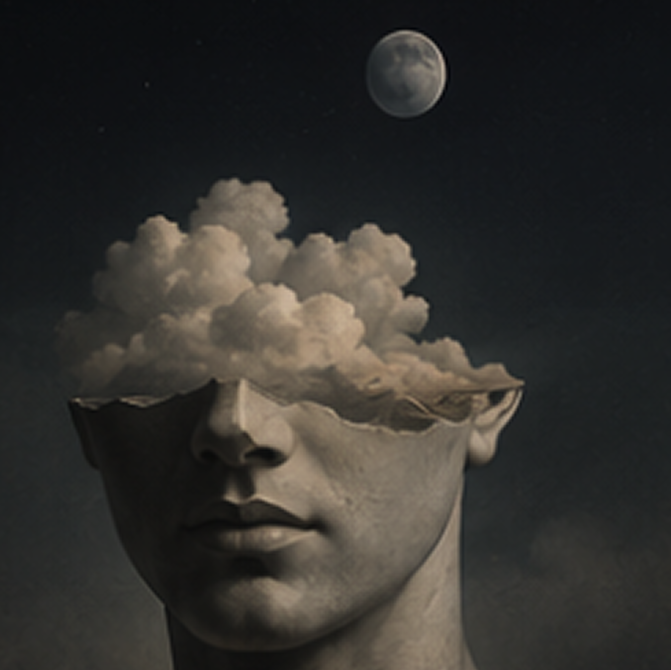
Sinebrychoff’s “Night” turns sleep into a collective dream world because it treats the nighttime not as empty darkness, but as a shared emotional landscape. On view at the Sinebrychoff Art Museum in Helsinki, Finland, from February 12 to August 23, 2026, the exhibition explores night, sleep, dreams, loneliness, bedtime rituals, nightmares, poetry, folklore, and the strange images that rise when daily order loosens its grip.
For thesurrealists.org, the exhibition matters because it places the dream back where Surrealism first found so much of its power: between private experience and collective imagination. Dreams feel personal, but they are also culturally repeated. We dream of animals, rooms, death, travel, childhood, falling, return, warning, pursuit, and impossible transformations. Sinebrychoff’s Night understands that double nature. It presents sleep as intimate and universal at the same time.
The official Night exhibition page describes the show as a journey from dusk to dawn, built around the many faces of night: kind, sad, scary, and serene. It also states that the exhibition includes old European art plus paintings, prints, and sculptures from the 19th century to the present day, all from the Finnish National Gallery’s own collection. The exhibition is curated by Kersti Tainio, includes poetry written by Henriikka Tavi, and features exhibition architecture by designer Lauri Johansson.
That mix makes Night more than a themed museum display. It becomes an atmospheric artwork about what happens when people stop working, stop performing public life, and enter the unstable territory of dreams.
Why “Night” Feels So Relevant In 2026
The timing of Night feels unusually sharp because contemporary life has made sleep both precious and fragile. People track it, optimize it, lose it, medicate it, interrupt it with screens, and romanticize it as a form of recovery. Yet sleep still refuses complete control. It remains a nightly surrender to something older, stranger, and less manageable than the productivity culture built around daylight.
The Sinebrychoff exhibition recognizes that nighttime does not mean the same thing for everyone. The museum’s description points directly to tired parents, night workers, nightmare sufferers, and homeless wanderers. That detail is important because it prevents the exhibition from becoming a soft, decorative fantasy of moonlight. Night can be restful, but it can also be frightening, lonely, laborious, exposed, or sleepless.
This is where the exhibition becomes especially useful for Surrealist criticism. Surrealism has often been linked to dreams, but not all dreams are beautiful. Some are comic, some erotic, some violent, some prophetic, some mundane, and some difficult to remember. A serious dream exhibition must hold all of those possibilities at once.
Sinebrychoff’s Night appears to do exactly that. It does not explain sleep away. It allows night to remain unstable.
How Sinebrychoff Turns A Museum Into A Nocturnal Space
The Sinebrychoff Art Museum is already a historically layered setting. The museum says it holds the most important collection of Old Masters in Finland, and its identity is tied to European art, collecting history, and the former home-museum world of Paul and Fanny Sinebrychoff. That institutional context gives Night an unusual atmosphere because old art and contemporary dream imagery are not separated into fixed periods. They are made to share the same nocturnal space.
The exhibition is located on the museum’s 1st floor, but its conceptual movement is temporal rather than architectural: dusk, sleep, dream, nightmare, and dawn. That structure matters because it turns the visitor’s route into something like a sleep cycle. The museum is not just showing images of night. It is asking visitors to move through night as a state of mind.
The Sinebrychoff Art Museum homepage confirms the exhibition’s 2026 dates and situates it within the museum’s broader program. But the deeper significance comes from how the exhibition uses design. Press materials for Night describe the exhibition architecture as stage-set-like, with Lauri Johansson shaping the nocturnal mood rather than merely arranging walls.
That theatrical quality matters. A dream is not only something seen. It is something entered.
Why Poetry Changes The Exhibition’s Meaning
One of the most distinctive features of Night is its collaboration with poet Henriikka Tavi. Instead of relying only on conventional wall texts, the exhibition uses poetry as an interpretive guide. The museum’s press materials explain that Tavi wrote poems in dialogue with the selected artworks and that poetry became an integral part of the exhibition as a whole.
This is a strong curatorial decision because dreams often resist explanatory language. A standard label can tell visitors who made an artwork, when it was made, and what it represents. A poem can do something else. It can echo the artwork’s mood, deepen its ambiguity, and give viewers permission to respond associatively rather than only historically.
That approach suits the subject of night. Sleep is not linear. Dreams do not behave like academic arguments. They jump, compress, repeat, disguise, and transform. Poetry is better equipped than ordinary prose to approach that logic without flattening it.
For thesurrealists.org, this matters because Surrealism was never only a visual movement. It was also literary, poetic, theatrical, and philosophical. André Breton’s Surrealism grew from writing as much as painting. MoMA’s Surrealism and Dreams overview connects the movement to dreams, the unconscious, and the radical release of imagination. Sinebrychoff’s Night extends that lineage by letting poetry and images work together as a contemporary dream apparatus.
How Dreams Become Collective Without Losing Privacy
The museum’s description of dreams as both collective and private gives the exhibition its central tension. A dream belongs to one sleeper, yet dream patterns travel across cultures and generations. People dream of animals, darkness, water, houses, death, lost objects, impossible rooms, flight, falling, and return. These images feel private when experienced, but they often belong to a shared symbolic vocabulary.
This is why Night turns sleep into a collective dream world. The exhibition does not treat dreams as isolated psychological secrets. It places them inside art history, poetry, folklore, family experience, and museum space. The visitor becomes one dreamer among many.
That framing is especially powerful because the exhibition includes materials connected to the Finnish Literature Society’s archive cards documenting Finnish folklore about dreams and premonitions. These archival elements matter because they move the show beyond individual artworks. They suggest that dreams have long been stored, interpreted, feared, and retold as part of communal life.
A dream written on an archive card is no longer only a fleeting private event. It becomes cultural evidence. It shows how communities have used dreams to think about money, death, warning, good and evil, and the uncertain future.
Why The Exhibition’s Animals Matter
The official exhibition materials foreground Saara Salmi’s Rabbit, from the series About Alice and the Rabbit, made in 2011. The image of a rabbit with shining eyes is an ideal emblem for a dream exhibition because it immediately evokes the logic of pursuit, threshold, and transformation. A rabbit can be an animal, a guide, a trickster, a childhood reference, or the beginning of a fall into another world.
The exhibition also includes references to sheep through works by Karel Dujardin and Johann Heinrich Roos, connecting the familiar bedtime ritual of counting sheep to older prints and pastoral imagery. This is a clever curatorial move because it turns a cliché of sleep into an art-historical pathway. Counting sheep is usually treated as a small domestic ritual. In Night, it becomes a visual bridge between bedtime practice, animal imagery, and the older European collection.
Animals often behave strangely in dreams because they carry too many meanings at once. They are familiar and unknowable, domestic and wild, symbolic and physical. In Surrealist art, animals frequently act as carriers of the unconscious. They are not merely decorative motifs; they are messengers from another order of thought.
This connects naturally with thesurrealists.org’s earlier writing on nature and the subconscious mind in Surrealist art, where natural forms become entrances into hidden psychic life. Sinebrychoff’s Night uses animals in a similar way: as soft, strange guides into the borderland of sleep.
How Moonlight Makes The Old Masters Feel Surreal
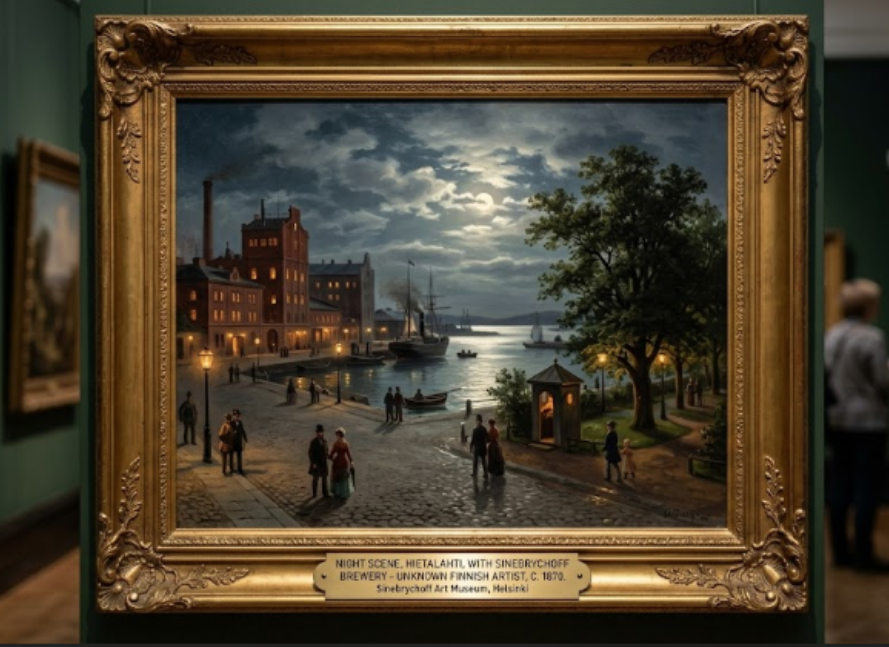
The exhibition’s journey begins with evening and moonrise, and the press materials name Ivan Aivazovsky and Albert Edelfelt among the artists whose works engage the moon. This is an important point because moonlight changes the logic of representation. It does not illuminate the world in the same way as daylight. It softens edges, distorts distance, and makes ordinary places feel theatrical.
Aivazovsky, born in 1817 and dead in 1900, is best known for atmospheric seascapes and light effects, while Edelfelt, born in 1854 and dead in 1905, remains one of Finland’s major 19th-century painters. Bringing artists like these into a dream exhibition shows how older art can become newly strange when viewed through a nocturnal framework.
Moonlit paintings are not automatically Surrealist, but they can produce a pre-Surrealist instability. A landscape by moonlight becomes less certain than the same scene by day. A shoreline, room, or field can start to feel suspended between memory and vision.
That is one of the exhibition’s strongest possibilities. By shifting the interpretive frame from “landscape” or “genre scene” to “night,” Sinebrychoff encourages viewers to see familiar art-historical material as dream material.
Why Night Includes Loneliness, Labor, And Fear
A weaker exhibition about night might have stopped at stars, moonlight, pillows, and fairy-tale sleep. Sinebrychoff’s Night is more interesting because it acknowledges the people for whom night is not restful. The museum explicitly names night workers, sleepless parents, nightmare sufferers, and homeless wanderers. These figures widen the exhibition’s emotional range.
Night is not evenly distributed. For some people, it is protection; for others, it is exposure. For some, it is romance; for others, exhaustion. For some, it is the time of dreams; for others, work or fear. This social awareness gives the exhibition depth.
Surrealism often explored the irrational, but the irrational is not separate from lived conditions. A nightmare may be private, but it can be shaped by stress, poverty, illness, war, parenthood, grief, work, housing insecurity, or collective anxiety. Sinebrychoff’s decision to include sadness and loneliness alongside serenity and wonder makes the exhibition more honest.
That honesty is important for modern audiences. In 2026, sleep is frequently discussed as a wellness goal, but Night reminds us that rest is also social. Not everyone has equal access to safe darkness.
How Folklore Gives Dreams A Public Memory
The inclusion of Finnish folklore about dreams and premonitions is one of the most compelling parts of the exhibition because it shows that dreams have long been treated as meaningful public material. People have recorded dreams, interpreted them, feared them, and shared them because dreams seem to cross the boundary between inner life and external fate.
Premonitory dreams are especially powerful because they challenge rational time. They suggest that the future can send images backward into the sleeping mind. Whether one believes in that literally is less important than the cultural function. Premonition turns the dreamer into a receiver of hidden signals.
This is exactly the kind of territory Surrealism found irresistible. The dream is not merely a private movie. It becomes a crack in ordinary causality. Past, future, desire, fear, memory, and symbol collapse into a single image.
By including archival dream materials, Sinebrychoff’s Night gives the exhibition a documentary layer. The museum does not only show artists imagining dreams. It also points toward ordinary people remembering and recording them. That makes the collective dream world more democratic.
Why “Night” Works As A Total Work Of Art
Museum Director Kirsi Eskelinen framed the exhibition as a new concept in which collaboration with a poet opens new interpretations and architecture intensifies the nocturnal atmosphere. Even without leaning on the exact wording, the point is clear: Night is designed as an immersive whole rather than a simple selection of individual works.
This matters because night is not a subject that can be contained by one image. It is an environment. It includes darkness, silence, fear, fatigue, intimacy, work, weather, animals, lamps, thresholds, beds, reading, waking, and dream travel. A successful exhibition about night must therefore work through atmosphere as much as content.
The collaboration among Kersti Tainio, Henriikka Tavi, and Lauri Johansson gives the show a layered structure. The curator selects and organizes the art. The poet opens associative pathways. The designer builds the mood. Together, they turn the gallery into something closer to a dream chamber.
That approach also makes sense for families. The museum’s press materials note that younger visitors were considered in the design, with works hung low and activities offered for children. This detail is important because children often enter dream and story worlds with less resistance than adults. The exhibition does not simply explain dreams to children; it lets them participate in the mood.
How Contemporary Works Push The Dream Forward
Although Sinebrychoff is known for old European art, Night is not limited to historical works. The exhibition includes pieces from the 19th century to the present, and the press materials point to contemporary connections in the works of Saara Salmi and Mikko Ängeslevä. That timeline lets the show treat night as a recurring human condition rather than a period style.
The contemporary works matter because the dream world has changed. Modern dreams can include electric light, television, digital anxiety, climate fear, urban loneliness, cinematic memory, and online images. The exhibition’s broader collection scope allows older symbols and newer visual languages to meet.
That meeting creates one of the richest possibilities for the show. A 17th-century print of sheep, a 19th-century moonlit scene, a contemporary rabbit, and an archive card about a premonitory dream do not belong to the same historical category. But under the sign of night, they begin to speak to each other.
That is how a museum turns sleep into a collective dream world. It lets different centuries dream in the same room.
Why The Exhibition Belongs In A Surrealist Conversation
Night belongs in a Surrealist conversation because it centers the dream without reducing it to decoration. The exhibition’s premise intersects with the core Surrealist belief that dreams, chance, irrational association, and the unconscious could reveal dimensions of reality that daylight reason suppresses.
The National Galleries of Scotland’s Surrealism glossary describes Surrealism as a literary and artistic movement that explored the subconscious mind, dreams, chance, and otherworldly imagery. Sinebrychoff’s exhibition is not a Surrealist exhibition in the narrow historical sense, but it clearly touches the same symbolic field.
Its difference is also important. Rather than focusing only on canonical Surrealist artists, Night approaches dream imagery across collections, periods, poetry, folklore, and exhibition design. That makes it less about Surrealism as a movement and more about the conditions that made Surrealism possible: sleep, fear, image memory, nighttime rituals, and the strange universality of dreams.
For readers of thesurrealists.org, that broader frame is valuable. It reminds us that Surrealism did not invent the dream. It inherited a long human habit of treating night as a second world.
Why Sleep Becomes A Shared Exhibition Space
Sleep is often imagined as the most private state. The sleeper withdraws from public life, closes the eyes, and disappears inward. Yet Night reverses that privacy by bringing sleep into the museum. It makes the private dream walkable, readable, visible, and shareable.
This transformation is subtle but powerful. A museum visitor cannot enter another person’s actual dream. But the visitor can move through artworks, poems, archive materials, animal images, moonlit scenes, and staged nocturnal spaces that approximate the way dreams move through culture. The exhibition becomes a social form of dreaming.
That is why the title Night is so effective. It is simple enough to include everyone. Everyone has some relation to night: child, worker, parent, insomniac, artist, reader, dreamer, and wanderer. The title does not narrow the subject. It opens it.
The exhibition’s strongest idea may be that sleep is not only biological. It is cultural. We surround it with stories, rituals, fears, songs, animals, lamps, books, myths, prayers, and interpretations. Sinebrychoff gathers those materials and asks viewers to feel how much meaning enters the room after dark.
How “Night” Turns Darkness Into A Collective Dream World
Sinebrychoff’s Night turns sleep into a collective dream world by refusing to separate art history from human vulnerability. The exhibition understands that night can be beautiful, but also lonely; peaceful, but also haunted; private, but also shared; ancient, but still changing.
Its strength lies in the way it connects many kinds of night. The moonlit night of old European art. The bedtime night of stories and sheep. The lonely night of the sleepless. The working night of those who cannot rest. The frightening night of nightmares. The folkloric night of premonitions. The contemporary night of skewed images and strange animals. The poetic night that cannot be explained without being diminished.
For a Surrealist arts site, this is exactly the kind of exhibition that deserves attention. It shows how the dream survives outside the usual Surrealist canon, moving through museums, folklore archives, children’s rituals, poetry, and the darkened rooms of ordinary life.
As the exhibition nears its final weeks in August 2026, its central idea feels timely: the night is not empty. It is a vast shared image-space. We enter it separately, but we do not dream alone.