
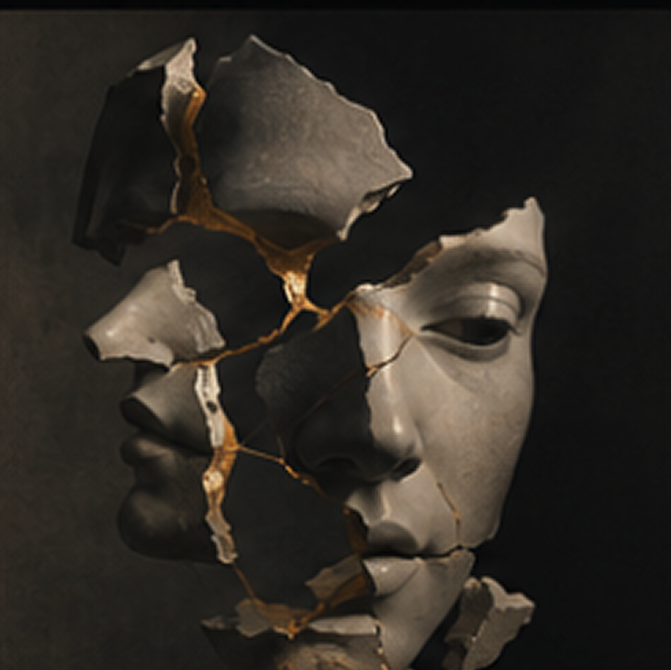
Leonor Fini: Regarde, on dirait des humains makes hybrid creatures feel human because it treats fantasy as a way to examine identity, gender, performance, intimacy, and the unstable border between person and animal. On view at the Musée de l’Hospice Saint-Roch in Issoudun, France, from February 14 to December 30, 2026, the exhibition marks the 30th anniversary of Fini’s death in 1996 and brings renewed attention to an artist who moved near Surrealism without letting the movement define her.
For thesurrealists.org, the exhibition matters because Fini’s art occupies a charged place in twentieth-century visual culture. Her creatures are not decorative fantasies. They look back. They perform. They change gender, species, costume, and role. They turn the hybrid body into a tool for asking what “human” means when identity refuses fixed categories.
The official Musée de l’Hospice Saint-Roch exhibition page describes Fini as a free and independent artist close to her Surrealist friends, while emphasizing portraits, enigmatic faces, fêtes galantes, felines, fantastic creatures, literary illustration, theater design, and ballet costume work. That mix is essential. Fini’s hybrids do not come from one source. They grow from painting, theater, literature, fashion, cats, masks, and the artist’s lifelong refusal to obey a single artistic identity.
Why The 2026 Exhibition Reframes Fini Now
The Issoudun exhibition arrives at a moment when museums and readers continue to re-evaluate women artists who stood beside Surrealism but resisted its male-centered mythology. Fini fits that re-evaluation perfectly. She knew major Surrealist figures, exhibited around them, and shared their fascination with dreams, masquerade, erotic tension, and the irrational. Yet she never accepted a subordinate role inside André Breton’s orbit.
That independence matters because Fini’s art does not simply repeat Surrealist formulas. It shifts the center of power. Her women, sphinxes, cats, masked figures, theatrical bodies, and androgynous subjects often appear self-possessed rather than available. The viewer does not master them. They seem to decide how much of themselves to reveal.
The 2026 exhibition’s title comes from Fini’s 1978 book L’Onéiropompe, where the phrase “Regarde, regarde on dirait des humains” appears. In English, the line suggests, “Look, look, they look like humans.” That phrasing is playful, unsettling, and exact. It implies that the human is not obvious. It must be recognized, doubted, and reimagined.
That is why this topic feels so strong for a Surrealist arts site. Fini’s hybrids do not make humanity disappear. They make humanity stranger, more theatrical, and more alive.
How Issoudun Became A Fini Memory Site
The Musée de l’Hospice Saint-Roch is not treating Fini as a passing exhibition subject. The museum has a long relationship with her work, including a first exhibition in 1991 and a permanent connection through the Salon Leonor Fini, transferred and reconstituted from her celebrated Paris apartment on rue de La Vrillière.
The museum says the salon has been reassembled in Issoudun since 2007 and includes 150 emblematic objects that reflect Fini’s personality and taste for Art Nouveau. That detail matters because Fini’s art cannot be separated easily from rooms, costumes, objects, furniture, books, and social performance. Her world was not only painted on canvas. It was staged.
The exhibition gathers nearly 70 works, including many unpublished drawings from the Cécile Reims collection, around 20 inks and paintings from private collections, works from the museum’s own holdings, and a recent donation of books from Fini’s personal library by Richard Overstreet – Succession Leonor Fini. It also includes a Centre Pompidou long-term loan: Femme travestie, a 1931 oil on canvas.
That combination turns the show into more than a display of images. It becomes an archive of an artistic atmosphere. Fini’s hybrid creatures feel human because they come from a complete world of gestures, rooms, books, costumes, and chosen identities.
Why Hybrid Creatures Were Central To Fini’s Art
Fini’s creatures often blur human, animal, mythological, theatrical, and erotic identities. The museum’s exhibition description specifically names felines, hybrid creatures, fantastic beings, enigmatic faces, and portraits among her preferred themes. Those categories are not separate in her art. They overlap constantly.
A Fini hybrid may be part woman, part sphinx, part cat, part theatrical apparition, and part psychological self-portrait. It may seem ancient and modern at the same time. It may feel like myth, but it also carries the sharp self-awareness of a person deciding how to appear in public.
This is why the hybrids feel human. They do not function as monsters. They function as intensified selves. They make visible the way people already live through masks, roles, poses, desires, social codes, and private mythologies.
The official Leonor Fini biography notes that one of her dominant themes was the complex relationship between the sexes, especially the interplay between dominant female figures and passive, androgynous male figures. It also states that the female form often appears as a sphinx, sometimes with the artist’s own face. In other words, Fini used the hybrid body to rethink power.
The creature becomes a social critique. It asks why one body should remain one thing.
How Fini Made The Sphinx Personal
The sphinx is one of Fini’s most important figures because it combines mystery, danger, beauty, intelligence, animal force, and self-command. In traditional myth, the sphinx tests human knowledge. In Fini’s art, the sphinx also tests gender roles and visual power.
Her sphinxes often do not appear as passive symbols. They seem alert, guarded, and sovereign. They can be seductive, but they also resist possession. Their hybridity gives them authority. They are not incomplete because they combine forms. They are powerful because they refuse reduction.
This is where Fini differs from many male Surrealists who used women as muses, dolls, dream figures, or psychological screens. Fini’s hybrid women are not merely dream objects. They frequently appear as dream authors. They create the scene’s terms.
La Biennale di Venezia’s Leonor Fini profile connects Fini’s art to masquerade, gender reversal, and the empowered mythological figure of the sphinx: part woman, part feline. It also notes that Fini rejected André Breton’s view of women and declined to officially join the Surrealist group.
That history matters because it clarifies the emotional intelligence of her hybrids. They are not strange because they fail to be human. They are strange because they know too much about how humans perform humanity.
Why “Femme Travestie” Sharpens The Exhibition’s Argument
The Centre Pompidou’s Femme travestie is especially important to the Issoudun exhibition because it places gender performance near the start of Fini’s public career. The Centre Pompidou collection entry identifies the work as a 1931 oil on canvas by Leonor Fini, measuring 65 x 46 cm, acquired as a donation in 1932, and currently at the Musée de l’Hospice Saint-Roch as part of a long-term loan from February 13, 2026, to January 1, 2030.
A title like Femme travestie immediately complicates stable identity. The figure is not simply “woman” in a fixed descriptive sense. The painting signals disguise, transformation, role play, and social costume. That matters because Fini’s later hybrid creatures often expand the same logic beyond clothing and into species, myth, and anatomy.
In Fini’s world, travesty is not only deception. It is revelation. A costume can expose truths that ordinary appearance hides. A mask can make identity more honest by admitting that identity is already performed.
This helps explain why her hybrid creatures feel so human. They make visible what polite portraiture often conceals: the self as arrangement, strategy, ritual, fantasy, and defense.
How Theater And Costume Shaped Fini’s Figures
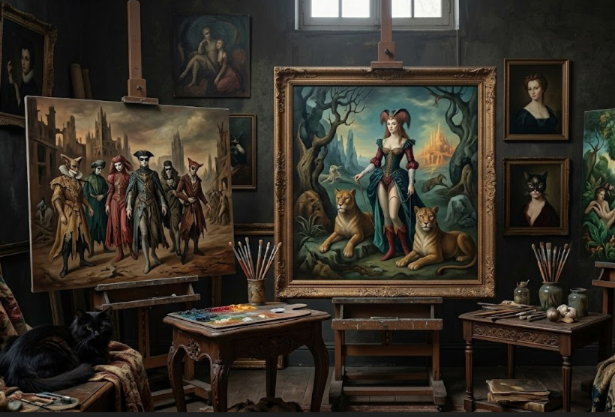
Fini’s art feels theatrical because theater was not a side interest for her. It was part of her artistic method. She created designs for ballet, theater, opera, and film, and her biography lists work connected to the Paris Opera, the Metropolitan Opera Association, George Balanchine’s Le Palais de cristal, Jean Genet’s The Maids, Federico Fellini’s 8 1/2, and other stage and screen projects.
That theatrical experience changed how she painted bodies. Her figures often seem aware of staging. They pose, recline, watch, confront, disguise, or gather in ritualized arrangements. Even when the setting is dreamlike, the figures have presence. They know they are being seen.
The Issoudun exhibition emphasizes this aspect by linking Fini’s drawings, paintings, and engravings to her talent for literature, ballet, and theater. That source-backed detail matters because it prevents a shallow reading of her fantasy imagery. These are not random dream creatures. They belong to a theatrical imagination trained to think through costume, scene, gesture, and transformation.
A hybrid creature in Fini’s art can therefore be understood as a kind of performer. It wears its own metamorphosis as costume. It turns identity into a stage event.
Why Felines Made Fini’s Humanity Stranger
Cats appear throughout Fini’s life and image-world, but they are not only biographical decoration. In her art, feline forms sharpen the question of autonomy. A cat is domestic and wild, affectionate and indifferent, elegant and predatory. It accepts closeness without surrendering its independence.
That makes the feline body a powerful model for Fini’s figures. Her sphinxes, cat-women, and watchful creatures often carry the same tension. They seem available to be seen, but not controlled. They allow proximity without offering obedience.
This is one reason Fini’s hybrids feel more human than monstrous. They express the contradictions of social life. People also balance intimacy and distance, display and privacy, softness and aggression, costume and instinct.
The museum’s emphasis on felines and fantastic creatures helps locate this tension at the center of the 2026 exhibition. Fini’s cats are not cute motifs. They are structural symbols for a world where identity has claws.
How Fini Resisted The Surrealist Label
Fini’s relationship to Surrealism should be handled carefully. She was close to Surrealist artists and writers, but she did not define herself as a formal member of the group. That distinction is not a small biographical note. It shapes how her art should be read.
MoMA’s Surrealism and Dreams overview explains how Surrealism sought to challenge rational control through dreams, subconscious associations, automatism, and the liberation of thought. Fini shared some of that imaginative territory, especially in her use of metamorphosis, fantasy, erotic ambiguity, and symbolic staging.
Yet Fini’s art does not feel like an illustration of Bretonian doctrine. It often feels more self-directed, more theatrical, and more skeptical of fixed movement identities. Her refusal to belong completely becomes part of the work’s power.
This connects with thesurrealists.org’s earlier writing on symbolism in Surrealist art, because Fini’s symbols rarely settle into a single meaning. A sphinx can be self-portrait, guardian, erotic figure, feminist reversal, mythological body, feline fantasy, and theatrical mask at once.
That refusal of single meaning is exactly why her creatures remain alive.
Why The Cécile Reims Connection Matters
The 2026 exhibition also foregrounds Cécile Reims, whose collection supplies many of the drawings shown in Issoudun. The museum says the Salle Fred Deux and Cécile Reims presents a selection of Fini prints engraved by Reims, and that the museum preserves nearly 600 engravings, including illustrated books and portfolios, connected to this important artistic relationship.
That detail adds depth to the exhibition because engraving is a medium of translation. Reims did not simply “copy” images in a mechanical way. As an interpretive engraver, she transformed drawings into prints through line, pressure, incision, texture, and tonal intelligence.
For Fini’s hybrid creatures, this matters. The engraved line can make metamorphosis feel precise. It can define fur, hair, skin, fabric, gesture, and gaze without making the image too literal. It keeps the creature suspended between body and sign.
The Reims connection also reminds readers that Fini’s art circulated through books, portfolios, illustrations, and graphic works, not only paintings. Her human-like creatures belong to a literary and printed culture as much as to gallery walls.
How The Salon Turns Biography Into Atmosphere
The Salon Leonor Fini is one of the exhibition’s most distinctive elements because it preserves the artist’s environment rather than only her images. The reconstitution of her Paris salon in Issoudun gives visitors access to the taste-world surrounding the work: furniture, objects, Art Nouveau forms, books, and theatrical self-fashioning.
This matters because Fini lived identity as an art. Her rooms, clothing, relationships, cats, objects, and social presence formed part of the same imaginative system as her paintings. The salon makes that system visible.
A standard museum display can sometimes isolate artworks from the life that gave them pressure. The Issoudun presentation moves in the opposite direction. It asks viewers to consider Fini’s hybrid creatures as extensions of a built personal mythology.
That personal mythology should not be reduced to gossip or eccentricity. It was a serious artistic structure. Fini made a world in which masks, animals, books, costumes, and human bodies could communicate across categories.
That is why the exhibition’s title feels so exact. “They look like humans” may describe the creatures, but it may also describe us when seen through Fini’s eyes.
Why Fini’s Hybrids Feel Modern
Fini’s hybrid creatures feel modern because they speak directly to current conversations about gender fluidity, self-presentation, nonhuman kinship, performance, fantasy identity, and the instability of the body. Her art does not use contemporary terminology, but it stages problems that contemporary audiences recognize quickly.
A hybrid body refuses the demand to choose one category. A masked figure refuses the fantasy that the face is transparent. A sphinx refuses passivity. A feline woman refuses domestication. An androgynous figure refuses the old division between masculine authority and feminine objecthood.
These themes make Fini’s work feel fresh without requiring an anachronistic reading. The point is not that Fini “predicted” current debates in a simple way. The point is that her art understood identity as a scene of negotiation long before many institutions made that understanding central.
The Issoudun exhibition gives viewers a chance to see this across media: drawings, paintings, prints, books, salon objects, and the Centre Pompidou loan. That breadth helps show how consistent Fini’s questions were across decades.
Why The Human Appears Through The Nonhuman
The strongest paradox in Regarde, on dirait des humains is that Fini makes the human clearer by moving away from ordinary human form. Her hybrid creatures reveal desire, guardedness, intelligence, threat, tenderness, performance, and solitude. They show human life by refusing human normality.
This is not escapism. It is analysis through fantasy. Fini’s creatures let the viewer see social roles from the outside. Once a woman becomes a sphinx, a face becomes a mask, or a figure becomes partly feline, the rules of ordinary portraiture break. The viewer must ask what identity is doing, not only what it looks like.
That is why Fini’s creatures do not feel cold or purely symbolic. They feel psychologically present. Their bodies may be impossible, but their self-possession is recognizable.
The exhibition’s emphasis on portraits and enigmatic faces matters here. Fini never abandoned the face. She transformed it. The face becomes a surface where animal, myth, theater, and selfhood meet.
How Fini Changes The Surrealist Creature
Surrealism often used hybrid creatures to disturb rational order. Fini does that too, but with a different center of gravity. Her creatures do not merely shock the viewer with impossible combinations. They often create a new social order inside the image.
In many male Surrealist images, the strange woman can become a mystery to be solved or possessed. In Fini’s art, the strange figure frequently controls the mystery. She may look like a sphinx because she is the one asking the question.
That reversal matters. It changes the emotional temperature of the image. The hybrid creature is not a symptom of male anxiety. It becomes an active intelligence.
This is why Fini’s work continues to matter for readers interested in the history of Surrealism, Symbolism, fantasy, and feminist visual culture. She does not simply add women to a movement already defined elsewhere. She changes what the movement’s creatures can mean.
Why “Regarde, On Dirait Des Humains” Feels Like A Challenge
The title Regarde, on dirait des humains sounds almost casual, but its challenge is deep. It asks viewers to look again at beings who resemble humans without fitting the category neatly. The phrase creates uncertainty before the image even appears.
Are these creatures almost human? Are humans already creatures? Is humanity a surface effect? Does resemblance matter more than essence? Fini’s art thrives inside those questions.
The 2026 Issoudun exhibition is valuable because it brings those questions into a focused institutional setting. It marks Fini’s 30-year posthumous anniversary while showing that her images remain difficult to domesticate. They are elegant, theatrical, erotic, witty, and strange. They can belong to Surrealist history without being absorbed by it.
That is the lasting force of the exhibition. It does not make Fini’s hybrids easier to define. It shows why definition was never the point.
How Fini Makes Fantasy Feel Like Recognition
Leonor Fini’s Regarde, on dirait des humains makes hybrid creatures feel human because it treats fantasy as a sharper form of recognition. The creature is not outside the human. It is the human intensified, disguised, defended, mythologized, and set free from ordinary naming.
The exhibition’s nearly 70 works, its unpublished drawings from the Cécile Reims collection, its private loans, its museum holdings, its Centre Pompidou loan, and its reconstructed salon all point toward the same idea: Fini built an art of metamorphosis that was also an art of self-possession.
Her hybrids still matter because they refuse to flatter the viewer’s need for stable categories. They ask us to recognize personhood inside animality, theater, costume, myth, gender reversal, and dream logic. They make the strange intimate.
That is why the title feels so powerful in 2026. Look again, Fini seems to say. They look like humans because humans were never as simple as they pretended to be.