
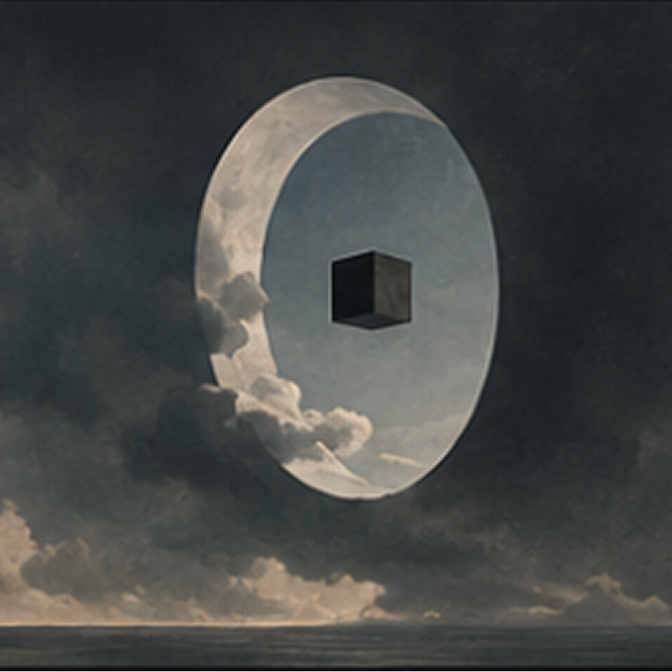
New Religion at Ngununggula in New South Wales turns devotion into a contemporary myth system built from old altarpieces, biblical imagery, queer reclamation, ghostly visions, apocalyptic drawings, and fragments of space junk. Curated by Milena Stojanovska, the exhibition runs at the Southern Highlands gallery until October 18, 2026, and asks a question that feels urgent in a culture shaped by screens, algorithms, billionaire space projects, climate anxiety, and unstable public faith: what do people worship now?
The exhibition’s answer is not simple. It does not argue that religion has vanished from contemporary life. Instead, it shows how older forms of awe keep returning through new materials and strange rituals. Historical works by figures such as William Blake, John Martin, and Albrecht Dürer sit beside contemporary Australian works that question, parody, reclaim, or re-stage spiritual imagery. In that collision, New Religion becomes less a show about doctrine than a show about meaning-making.
For thesurrealists.org, this matters because the exhibition treats myth as a living visual language rather than a closed historical category. It makes religious imagery feel unstable, theatrical, comic, painful, and technologically contaminated. Space debris can become relic. A confessional booth can become a place for queer image-making. Bosch’s garden can become a scene of pleasure, shame, and refusal. Devotion no longer stays inside the church or museum. It leaks into screens, wreckage, bodies, jokes, and ruins.
Why “New Religion” Feels Like A Contemporary Myth Machine
The most compelling idea in New Religion is that modern life has not escaped myth. It has only changed the objects through which myth appears. Older religious art often organized fear, judgment, ecstasy, suffering, paradise, punishment, and redemption into images that viewers could understand emotionally before they understood intellectually. Contemporary culture still needs those structures, but it often finds them in unexpected places.
Today, devotion can attach itself to technology, celebrity, wellness, online identity, political tribes, space travel, digital platforms, and the fantasy of escape. Objects that once looked like waste can acquire symbolic value. A rocket fragment can become a relic because people project awe onto the technological systems that produced it. A phone can behave like a devotional object because it structures daily attention. A billionaire space program can generate secular saints, prophets, and pilgrimage economies.
That is why Stojanovska’s framing feels sharp. The exhibition’s title sounds religious, but the stronger point is cultural. New Religion is about the ways people keep searching for awe when inherited spiritual images no longer hold the same authority. The show does not mock that search. It makes the search visible.
This approach connects naturally with thesurrealists.org’s interest in Surrealist methods and magical contrasts, because New Religion depends on charged collisions: sacred and profane, old and new, relic and debris, shame and humor, church and club, apocalypse and entertainment, myth and technology.
How Space Junk Becomes A Modern Relic
The exhibition’s most striking contemporary gesture appears in Talk Religion, Get Food by Claire Healy and Sean Cordeiro. According to recent coverage in The Australian, the installation uses fragments of SpaceX debris and draws on hobo glyphs, the practical signs itinerant workers used during the Great Depression to communicate where food, shelter, or safety might be found.
That combination is powerful because it turns technological waste into a symbolic language. Space debris normally suggests failed machinery, environmental residue, or the aftermath of launch culture. In Talk Religion, Get Food, it becomes something closer to a relic system: a material leftover invested with value because it touched a larger story about aspiration, power, survival, and belief.
The hobo-glyph reference grounds the work in need rather than spectacle. These were not abstract symbols. They were signs of movement, hunger, danger, hospitality, and social knowledge. By reimagining them through fragments of space junk, Healy and Cordeiro connect two very different kinds of wandering: the earthly movement of displaced workers and the skyward movement of privatized space ambition.
That tension gives the installation its mythic force. It asks whether contemporary society has replaced saints’ bones with technological wreckage. It also asks whether the new sacred objects actually help anyone survive. A relic traditionally promised contact with holiness. Space debris promises contact with the future. The installation makes that promise look both absurd and strangely believable.
Why Bosch Still Haunts Contemporary Devotion
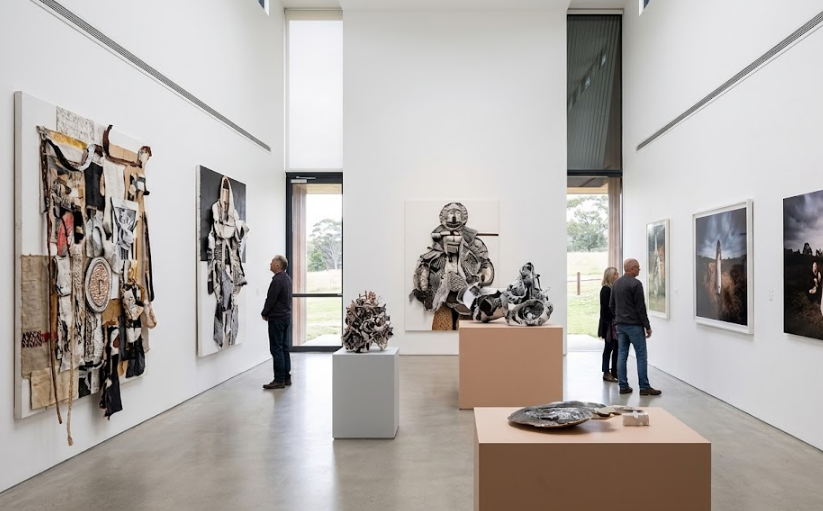
New Religion also draws force from Gian Manik’s engagement with Hieronymus Bosch’s The Garden of Earthly Delights. The original Bosch triptych, held by the Museo Nacional del Prado, dates to around 1490–1500 and remains one of the most enigmatic religious images in European art. The Prado’s official Bosch collection page describes the work as a complex vision organized around sin, false paradise, sensory deception, and punishment.
Manik’s painting, Happiness and Delight in These Pleasures with Punishments Meted Out to Each Sin, takes that inherited religious structure and turns it toward shame, sexuality, longing, and identity. Recent reporting describes the work as positioned within a confessional-like space, a display choice that keeps the exhibition accessible while intensifying its devotional atmosphere.
The Bosch reference matters because The Garden of Earthly Delights has always been a dream machine. Its hybrid creatures, oversized fruits, impossible architectures, naked bodies, strange instruments, and hellish punishments feel like a medieval unconscious made visible. Surrealists were drawn to such images because Bosch seemed to anticipate dream logic centuries before the term existed.
Manik’s reinterpretation changes the moral direction. Bosch warns against pleasure. Manik reclaims the image-world of religious warning as a way to process inherited shame. That shift turns old punishment imagery into contemporary myth. The garden no longer belongs only to sin. It becomes a place where identity, desire, memory, and doctrine collide.
How The Exhibition Uses Humor Without Losing Awe
Religious imagery often arrives with solemn expectations. Viewers may assume that sacred art must be reverent, heavy, or morally instructive. New Religion complicates that assumption by allowing humor into the devotional field. That is not a superficial choice. Humor can make old images newly reachable.
Stojanovska’s comments in The Australian emphasize that religious imagery does not have to remain serious in order to matter. Humor can create a point of connection with visual systems that otherwise feel distant, doctrinal, or intimidating. In a contemporary gallery, that matters. Viewers may not share the theological framework behind a Blake drawing, a Dürer print, a medieval altarpiece, or a Boschian scene, but they can still recognize irony, fear, absurdity, bodily awkwardness, and moral contradiction.
This is where the exhibition becomes especially Surrealist in spirit. Surrealism often used humor to fracture authority. It understood that laughter can destabilize what seems fixed. A sacred image can become strange when placed beside technological debris. An apocalyptic drawing can feel contemporary when viewed through climate dread or platform addiction. A devotional object can become comic without becoming meaningless.
In New Religion, humor does not destroy awe. It makes awe less controlled. The exhibition suggests that contemporary myth may require laughter because modern worship is already absurd. People bow to markets, feeds, brands, rockets, influencers, and ideologies while insisting they are rational. The show simply lets that contradiction show itself.
Why Historical Religious Art Still Feels Unsettling
The inclusion of historical works by William Blake, John Martin, and Albrecht Dürer gives New Religion a longer visual memory. These artists matter because each understood that religious imagery could become psychologically overwhelming. Blake’s visions turned scripture into charged inner theater. Martin’s apocalyptic scenes made catastrophe vast and cinematic. Dürer’s religious prints gave spiritual terror a precision that still feels intense.
Placed beside contemporary work, these historical objects do not act like background references. They become active participants. They show that religious art has always been a technology of imagination. Before screens, churches, books, prints, altarpieces, and paintings taught viewers how to picture invisible forces. Heaven, hell, guilt, grace, punishment, temptation, and revelation all needed images.
Contemporary audiences may not believe in the same systems, but the emotional architecture remains familiar. People still imagine collapse. They still fear judgment. They still seek transcendence. They still make images of power and project meaning onto objects. New Religion uses historical art to show that the present is not as secular as it thinks.
The exhibition’s strength lies in refusing a clean break between then and now. It does not treat old religious art as dead heritage. It treats it as a charged archive that contemporary artists can argue with, quote, distort, reclaim, or contaminate.
How The Show Connects Queer Reclamation To Sacred Imagery
One of the most important contemporary themes in New Religion is reclamation. Manik’s Bosch-inspired work gives this theme a clear emotional anchor because it uses biblical and religious imagery to explore shame, sexuality, longing, and identity. Rather than rejecting religious visual culture entirely, the work returns to it and alters its force.
That matters because religious imagery has often shaped the way bodies and desires are judged. For queer artists and audiences, sacred symbols can carry both injury and possibility. They may recall exclusion, guilt, punishment, or silence. Yet they can also become tools of transformation when artists seize them and remake their meanings.
In this sense, New Religion does not merely update religious art. It stages a contest over who gets to use it. The confessional format around Manik’s painting becomes especially pointed. Confession traditionally implies sin, secrecy, and moral authority. In the exhibition, it becomes a theatrical frame for an image that refuses shame as the final meaning.
This is contemporary myth-making at its strongest. Myth does not only preserve old stories. It lets people rewrite their place inside them. Manik’s work suggests that sacred imagery can become a site of survival when artists transform inherited judgment into self-authored symbolism.
Why Apocalypse Feels Contemporary Again
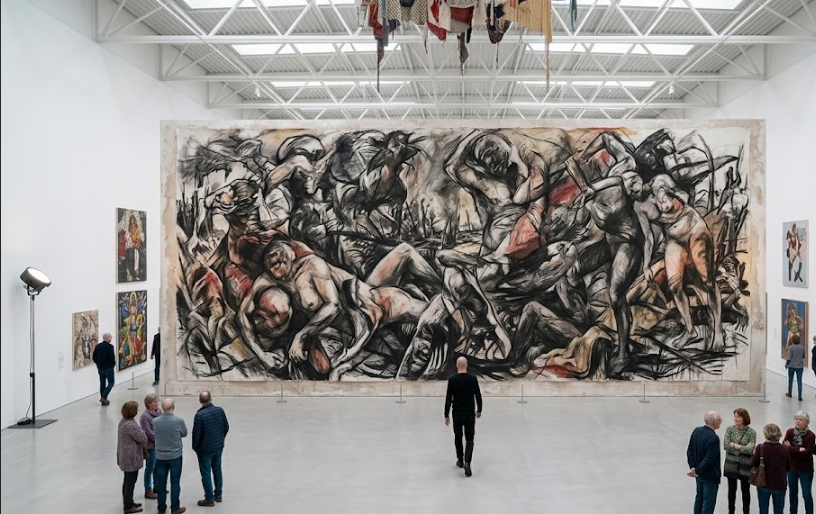
The exhibition’s apocalyptic current appears through historical works and contemporary responses, including Luke Thurgate’s large-scale wall drawing, described in recent reporting as an altarpiece-like work exploring apocalypse and menacing new gods. That phrase feels especially current in 2026. The new gods are not hard to name: technology, capital, extraction, data, spectacle, and the fantasy of escape from earthly limits.
Apocalypse has always been more than destruction. In religious tradition, it also means revelation: the uncovering of hidden truth. New Religion uses that double meaning. Space junk reveals what technological worship leaves behind. Boschian imagery reveals how shame can structure pleasure. Historical religious art reveals that earlier societies also pictured fear through overwhelming images.
A contemporary apocalypse may not arrive as a single fiery end. It may arrive through accumulation: environmental stress, digital dependence, social fragmentation, and the transformation of attention into commodity. The exhibition’s mythic language gives viewers a way to feel those pressures without turning them into simple political slogans.
This is why the show belongs on thesurrealists.org. Surrealism has always been interested in the moment when reality becomes too charged to remain realistic. Apocalypse, devotion, and dream logic all meet at that point. The world does not need to look fantastical to become mythic. It only needs to reveal the forces people already worship.
How Ngununggula Turns Regional Space Into A Mythic Stage
The location matters. Ngununggula is not a metropolitan mega-museum using spectacle to overwhelm viewers. It is a regional gallery in the Southern Highlands of New South Wales, and that setting helps the exhibition feel more intimate. The show’s questions about awe, devotion, and contemporary belief unfold away from the biggest global art-market centers.
That distance matters because myth often attaches itself to place. Regional galleries can make viewers encounter large symbolic questions at a different pace. In New Religion, the Southern Highlands context gives the exhibition room to feel reflective rather than purely spectacular. It lets space junk, medieval imagery, Boschian quotation, queer reclamation, and apocalyptic drawing operate as parts of a shared ritual field.
The regional setting also keeps the exhibition from becoming a detached theory exercise. New South Wales is a real landscape of rivers, towns, coastlines, colonial histories, spiritual traditions, and contemporary art networks. When technological debris appears there as a quasi-relic, it does not feel abstract. It feels like evidence that global systems leave material traces in local places.
That is part of the contemporary myth. The heavens are no longer distant. They fall back as fragments. The sacred no longer stays above. It lands on beaches, enters galleries, and becomes material for artists to rearrange.
Why Space Junk And Devotion Belong Together
At first, space junk and devotion seem like opposites. One belongs to failed hardware or technological waste. The other belongs to ritual, reverence, prayer, and meaning. New Religion brings them together because the modern world has already done so. Technology now carries emotional and symbolic weight once reserved for religion.
People watch rocket launches with awe. They follow technology founders like prophets or villains. They treat devices as extensions of self. They imagine escape from Earth through space colonization, virtual worlds, or artificial intelligence. They collect objects touched by these systems because proximity feels meaningful. That is relic thinking, even when the language is secular.
The genius of Healy and Cordeiro’s installation is that it makes this transfer visible. SpaceX debris is not sacred in itself. It becomes sacred because culture projects longing onto it. The work asks whether that longing is beautiful, foolish, dangerous, or all three.
This is where New Religion turns from exhibition into diagnosis. It does not simply show religious imagery in contemporary art. It shows how contemporary life manufactures religion-like attachments around objects of power. Space junk becomes myth because the culture already wants it to be myth.
Why “New Religion” Matters For Surrealist Visual Culture
New Religion matters for Surrealist visual culture because it treats the sacred as unstable, hybrid, and open to transformation. It understands that myth is not a dead inheritance but a visual engine. Artists can use it to process shame, survival, technological worship, environmental anxiety, humor, and the hunger for awe.
The exhibition also reminds viewers that Surrealism and religion have always shared certain image problems. Both deal with invisible forces. Both use symbols, transformations, hybrid bodies, impossible spaces, and charged objects. Both ask viewers to believe, if only for a moment, that reality has another layer.
The difference is that New Religion stages that second layer in contemporary terms. The relic may be rocket debris. The garden may be queer reclamation. The altarpiece may become a wall drawing about new gods. The apocalypse may look like technology’s residue rather than a medieval vision of fire.
That is why the exhibition feels so current. It shows that modern culture has not outgrown devotion. It has scattered devotion across stranger objects. Ngununggula’s show gathers those objects back together and asks viewers to recognize them as a mythic system.
Why Contemporary Myth Now Looks Like Space Junk
New Religion turns space junk and devotion into contemporary myth because it understands that belief survives by changing shape. The exhibition does not ask viewers to return to old religious certainty. It asks them to notice where awe, fear, shame, hope, and reverence have gone.
In Stojanovska’s exhibition, those forces appear in Boschian pleasure gardens, historical religious works, contemporary queer painting, ghostly visions, apocalyptic drawing, and fragments of privatized space ambition. The result is not a sermon. It is a visual argument about the present.
The strongest mythic image may be the simplest one: technological debris treated like a relic. That image captures a culture caught between spiritual hunger and material residue. People still want transcendence, but the objects left behind are broken, commercial, and earthly.
That tension makes New Religion more than a regional exhibition. It becomes a sharp contemporary allegory. The sacred has not disappeared. It has become stranger. It now appears in wreckage, screens, bodies, memories, and images that refuse to stay in one category. Ngununggula’s exhibition shows that contemporary myth is not waiting in the past. It is already here, glittering among the debris.