
Schiaparelli: Fashion Becomes Art at the Victoria and Albert Museum turns couture into a stage where the body becomes theater, joke, object, artwork, and dream image at the same time. On view at V&A South Kensington in London through November 8, 2026, the exhibition is the UK’s first exhibition on Elsa Schiaparelli and traces the fashion house from its 1920s origins to its present under creative director Daniel Roseberry. The V&A’s official Schiaparelli exhibition page frames the show around Schiaparelli’s own claim: “For me, dress designing is not a profession but an art.”
For thesurrealists.org, that statement gives the exhibition its strongest angle. Schiaparelli did not treat clothing as a quiet surface for elegance alone. She made garments act like arguments. A dress could become a skeleton. A hat could become a shoe. A lobster could move from Dalí’s absurd object world onto a white silk gown. A coat could carry a Cocteau face and a vase of roses across the wearer’s back. Schiaparelli: Fashion Becomes Art turns couture into a Surrealist stage because it shows fashion as a live space where dream logic touches the body directly.
Why The V&A Exhibition Makes Fashion Feel Like Art In Motion
Fashion exhibitions can sometimes turn garments into frozen luxury objects. Schiaparelli’s work resists that stillness. Her designs were made for bodies, salons, photographs, films, parties, performances, and public shock. The V&A’s decision to present her history through clothing, jewellery, artworks, photographs, perfume bottles, buttons, archival materials, and contemporary couture gives the show a broader visual field.
The exhibition highlights the fashion house’s origins and its evolution under Roseberry. That historical span matters because Schiaparelli’s legacy is not confined to the 1930s. The house still uses exaggeration, anatomical fantasy, theatrical silhouettes, and art-world references to turn couture into spectacle. The runway and red carpet now perform some of the same work once done by interwar salons and illustrated fashion magazines.
This is why the show fits a Surrealist website. Surrealism was never only about painting dream scenes. It changed the status of everyday objects. It made a telephone sprout a lobster, a body fragment into symbols, a face become a mask, and a room behave like a psyche. Schiaparelli translated that spirit into wearable form. The body became the gallery wall, but also the actor on stage.
The V&A’s own Elsa Schiaparelli collection page describes how she worked within traditional tailoring while using subversive details, extraordinary materials, and Surrealist imagery. That balance is vital. The garments shock because they are beautifully made. Their irrationality is supported by technical discipline.
How Schiaparelli Made The Body Behave Like A Surreal Object
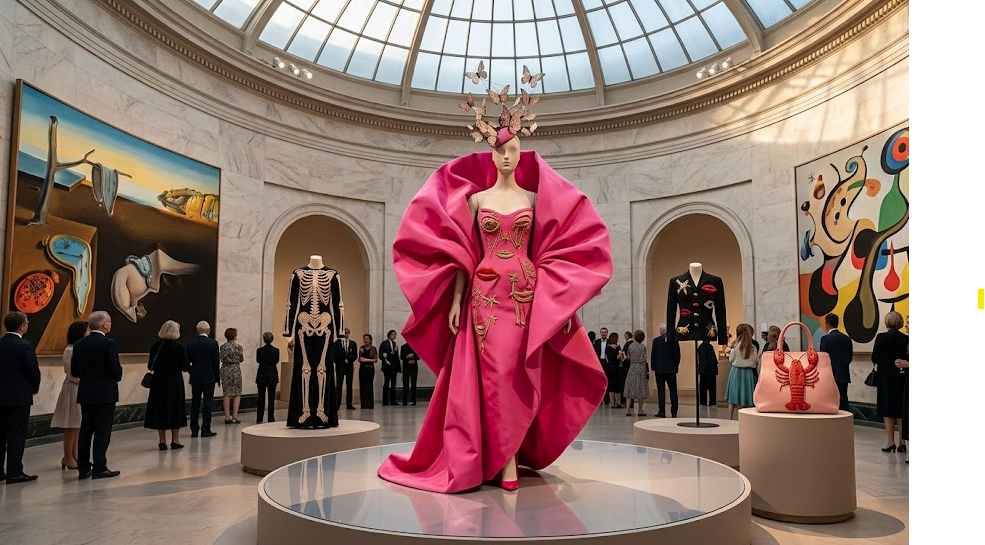
Schiaparelli’s most famous collaborations with Salvador Dalí and Jean Cocteau remain central because they turn the dressed body into a site of visual contradiction. The Skeleton Dress from 1938 uses raised quilting to place the structure of bones on the outside of the body. The Tears Dress with veil, also from 1938, turns fabric into an image of ripped skin or illusionistic damage. The Lobster Dress, created with Dalí, places an absurd sea creature across formal white silk.
These works are funny, elegant, and disturbing. Their power comes from the collision. Couture usually promises control, polish, and social distinction. Schiaparelli made it expose anatomy, appetite, vulnerability, and absurdity. She understood that a garment touches the body more directly than a painting. A Surrealist dress does not hang outside the self. It wraps the dream around the wearer.
AP’s March 2026 report on the exhibition notes that the show includes around 400 objects, including Dalí’s Lobster Telephone from 1938 displayed with the Lobster Dress, the Skeleton Dress, and an evening coat created with Cocteau. The AP Schiaparelli exhibition report also places Roseberry’s contemporary celebrity-worn designs within the same lineage of fashion as spectacle.
That connection matters because Schiaparelli’s Surrealist stage was never private. Her garments depended on being seen, photographed, discussed, and remembered. They produced social images. Today’s red carpet gives the house a different platform, but the logic remains close: the body appears as a deliberate visual event.
Why Dalí, Cocteau, And Man Ray Still Shape The Exhibition’s Mood
Schiaparelli’s place in Surrealist culture came through friendship, collaboration, and shared appetite for strange images. She worked with or moved near figures including Dalí, Cocteau, Man Ray, Leonor Fini, Meret Oppenheim, and other artists who understood fashion as more than commerce. Her Paris world treated couture, photography, publicity, interiors, and performance as connected creative forms.
The V&A’s exhibition highlights objects such as the Lobster Telephone by Dalí, the Cocteau evening coat, the Tears Dress, the Skeleton Dress, a Man Ray portrait of Schiaparelli from 1933, and a Pablo Picasso portrait of Nusch Éluard from 1937. That selection matters because it places Schiaparelli inside a network of artistic exchange rather than presenting her as a designer borrowing from famous male artists.
Schiaparelli’s strongest works do not feel like passive translations of Surrealist painting into fashion. They have their own intelligence. A hat shaped like a shoe is funny because the body has been rearranged. A skeleton dress is haunting because hidden anatomy becomes external decoration. A Cocteau coat is strange because the back of the body becomes a face, a vase, and an image surface at once.
This connects with thesurrealists.org’s earlier writing on Surrealist methods and magical contrasts, where unusual pairings become a way to make familiar reality unstable. Schiaparelli’s couture is built on exactly that pressure: silk against skin, elegance against shock, tailoring against dream, body against object.
How “Shocking Pink” Became A Surrealist Signal
Schiaparelli’s visual world cannot be understood through individual garments alone. Her use of color, branding, perfume, accessories, and salon culture helped create a total stage. Her famous Shocking Pink was more than a shade. It was a declaration that fashion could behave loudly, artificially, and theatrically.
Color mattered because Surrealism often sought to break the polite surface of bourgeois life. Schiaparelli’s pink did that through glamour instead of manifesto language. It made fashion feel electric, artificial, and unforgettable. A color could become attitude. A perfume bottle could become sculpture. A button could become a tiny joke. Jewellery could turn the body into a place of symbolic exaggeration.
Smithsonian Magazine’s coverage of the V&A show notes that visitors can see more than 400 objects related to Schiaparelli and her house, including jewellery, paintings, photographs, and 100 outfits. Its Schiaparelli Surrealist fashion report reinforces the exhibition’s central claim that Schiaparelli’s fashion was built through artistic collaboration and imaginative risk.
That risk is the reason her work still feels sharp. The garments do not ask the viewer to admire taste alone. They ask the viewer to notice how taste can become a weapon against normality. A Schiaparelli object is often elegant enough to enter elite society and strange enough to mock its rules from inside.
Why Daniel Roseberry Makes The Stage Contemporary Again
The V&A exhibition does not end with Elsa Schiaparelli as a closed historical figure. It follows the house into the present under Daniel Roseberry, who became creative director in 2019. That choice gives the article a current SEO hook because Roseberry’s Schiaparelli has become a major red-carpet and couture spectacle, known for sculptural forms, anatomy-inspired pieces, exaggerated gold body parts, and viral fashion moments.
Roseberry’s work matters because contemporary fashion now circulates through digital images at extraordinary speed. A couture look may be experienced by millions of viewers as a phone image before most people understand its craft. Schiaparelli’s old theatrical logic fits that environment unusually well. The house was always interested in the unforgettable image.
AP notes that the exhibition includes contemporary pieces such as a jewel-encrusted red gown worn by Ariana Grande at the 2025 Oscars during a Wicked performance. That detail shows how Schiaparelli’s stage has moved from the interwar salon to the awards broadcast. The body is still dressed as spectacle, but the audience has changed scale.
The risk for any revived fashion house is that Surrealism becomes branding rather than thought. Roseberry’s strongest work avoids that when it treats anatomy, material, and cultural performance as part of the design language rather than surface gimmick. The V&A show’s structure lets viewers compare historical shock with contemporary image-making and ask which forms of strangeness still work.
How Couture Turns The Museum Into A Performance Space
A museum exhibition about fashion has to solve a problem: garments were made to move, but museum displays often stop movement. Schiaparelli’s work intensifies that problem because so much of its meaning depends on social performance. A shoe hat changes when it sits on a mannequin. A dress designed to shock a room changes when it sits behind glass.
Yet that stillness can also sharpen the art. In the museum, viewers can study construction, surface, symbol, and reference with a kind of attention that fashion’s original social setting may not allow. The garment becomes both costume and object. The mannequin becomes a silent actor. The gallery becomes a stage where viewers reconstruct the missing performance.
That is why Schiaparelli: Fashion Becomes Art works as more than a brand retrospective. It asks visitors to think about fashion as image technology. Schiaparelli understood that clothing creates pictures before cameras capture them. Her designs were made to produce memory.
The exhibition also shows how fashion enters art history through networks of photography, publicity, illustration, performance, and celebrity. Man Ray’s portrait, Beaton’s fashion photographs, Dalí’s objects, Cocteau’s graphic line, and Roseberry’s red-carpet visibility all belong to the same broader question: when does dressing become staging?
Why Schiaparelli Still Matters To Surrealist Visual Culture
Schiaparelli matters because she treated the body as a site where Surrealism could become public, wearable, and socially disruptive. She did not simply decorate clothing with strange motifs. She changed what clothing could do. It could joke, disturb, expose, flatter, confuse, and perform. It could turn the wearer into an artwork without removing the wearer from social life.
That is the key difference between Schiaparelli’s strongest pieces and ordinary fantasy fashion. Her garments do not escape the world. They enter it with sharper teeth. A dinner dress becomes an image of bodily rupture. A tailored suit becomes a statement about modern women’s movement and authority. A shoe becomes a hat. A lobster becomes erotic, comic, and absurd on a white dress. An evening coat becomes a Cocteau drawing in motion.
For thesurrealists.org, this makes the V&A exhibition valuable because it connects historical Surrealism to fashion, gender, celebrity, commerce, and performance without reducing the work to spectacle. It shows that Surrealism did not remain locked in galleries or manifestos. It entered wardrobes, magazines, salons, photographs, shop windows, perfumes, jewellery boxes, and public memory.
The exhibition’s title is accurate because Schiaparelli made fashion behave like art. Yet the stronger point is that she made art behave like fashion: immediate, embodied, social, risky, and impossible to separate from performance.
Why Couture Still Feels Like The Stage Where Dreams Dress The Body
Schiaparelli: Fashion Becomes Art turns couture into a Surrealist stage because it shows clothing as a place where the impossible can briefly become wearable. The exhibition’s power lies in the way it moves between Elsa Schiaparelli’s 1930s artistic collaborations and Roseberry’s contemporary spectacle without treating either period as simple nostalgia.
The show reminds viewers that Surrealism’s most enduring force may be its ability to make the body strange. Schiaparelli did this through craft, humor, shock, collaboration, and social intelligence. She made garments that looked polished enough for elite life and unstable enough to make that life feel theatrical.
A Schiaparelli dress is never just a dress when it carries bones, tears, lobsters, faces, body parts, or impossible objects. It is a scene. It is an image event. It is a stage where the wearer and the artwork meet.
That is why the V&A exhibition feels so relevant in 2026. Contemporary culture is saturated with fashion images, yet Schiaparelli’s work still shows how rare true visual strangeness can be. The best couture does more than decorate the body. It changes what the body appears to mean. In Schiaparelli’s world, fashion becomes art because the dream does not stay on the canvas. It walks into the room.